


Your Worksheet is Ready
CBSE - Class 10 Mathematics Surface Areas and Volumes Worksheet
A right circular cylinder just encloses a sphere of radius r . Find
(i) surface area of the sphere,
(ii) curved surface area of the cylinder,
 (iii) ratio of the areas obtained in (i) and (ii).
. (i) 4πr 2 (ii) 4πr 2 (iii) 1 : 1
b.. (i) 2πr 2 (ii) 4πr 2 (iii) 1 : 2
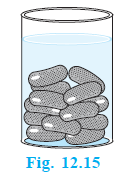
A gulab jamun, contains sugar syrup up to about $30\%$ of its volume. Find approximately how much syrup would be found in $45$ gulab jamuns, each shaped like a cylinder with two hemispherical ends with length $5$ cm and diameter $2.8$ cm (see Fig. 12.15).
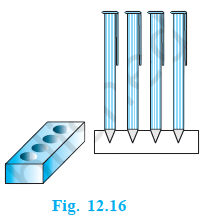
A pen stand made of wood is in the shape of a cuboid with four conical depressions to hold pens. The dimensions of the cuboid are $15$ cm by $10$ cm by $3.5$ cm. The radius of each of the depressions is $0.5$ cm and the depth is $1.4$ cm. Find the volume of wood in the entire stand (see Fig. 12.16).
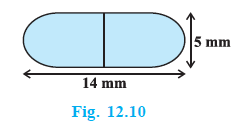
A medicine capsule is in the shape of a cylinder with two hemispheres stuck to each of its ends (see Fig. 12.10). The length of the entire capsule is $14$ mm and the diameter of the capsule is $5$ mm. Find its surface area.
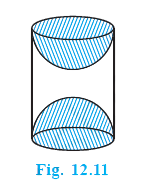
A wooden article was made by scooping out a hemisphere from each end of a solid cylinder, as shown in Fig. 12.11. If the height of the cylinder is $10$ cm, and its base is of radius $3.5$ cm, find the total surface area of the article.
The paint in a certain container is sufficient to paint an are equal to 9.375m2 , How many bricks of dimensions 22.5 cm X 10cm X 7.5 cm can be painted out of this container ?
120
b.100
c.86
d.90
Worksheet Answers
Solution:
Given:
To Find:
The volume of water left in the cylinder after the solid is submerged in it.
Step 1: Calculate the volume of the cylinder.
The formula for the volume of a cylinder is $V_{cyl} = \pi R^2 H$.
$V_{cyl} = \pi \times (60)^2 \times 180$
$V_{cyl} = \pi \times 3600 \times 180 = 648,000\pi \text{ cm}^3$.
Step 2: Calculate the volume of the solid.
The solid consists of a cone and a hemisphere. The total volume $V_{solid} = V_{cone} + V_{hemisphere}$.
Formula for volume of a cone: $V_{cone} = \frac{1}{3}\pi r^2 h_{cone}$.
$V_{cone} = \frac{1}{3} \times \pi \times (60)^2 \times 120 = \pi \times 3600 \times 40 = 144,000\pi \text{ cm}^3$.
Formula for volume of a hemisphere: $V_{hemisphere} = \frac{2}{3}\pi r^3$.
$V_{hemisphere} = \frac{2}{3} \times \pi \times (60)^3 = \frac{2}{3} \times \pi \times 216,000 = 2 \times \pi \times 72,000 = 144,000\pi \text{ cm}^3$.
Total volume of the solid $V_{solid} = 144,000\pi + 144,000\pi = 288,000\pi \text{ cm}^3$.
Step 3: Calculate the volume of water left in the cylinder.
When the solid is placed in the cylinder, it displaces a volume of water equal to its own volume. The volume of water left is the difference between the volume of the cylinder and the volume of the solid.
$V_{left} = V_{cyl} - V_{solid}$
$V_{left} = 648,000\pi - 288,000\pi = 360,000\pi \text{ cm}^3$.
Step 4: Convert to numerical value using $\pi \approx \frac{22}{7}$.
$V_{left} = 360,000 \times \frac{22}{7} \approx 360,000 \times 3.14159 \approx 1,131,428.57 \text{ cm}^3$.
Converting to cubic meters ($1 \text{ m}^3 = 1,000,000 \text{ cm}^3$):
$V_{left} \approx 1.131 \text{ m}^3$.
Final Answer: The volume of water left in the cylinder is $360,000\pi \text{ cm}^3$ or approximately $1.131 \text{ m}^3$.
Solution:
Given:
To Find:
Whether the child's measurement of $345$ cm$^3$ is correct by calculating the actual volume of the vessel.
Step 1: Calculate the volume of the cylindrical neck.
The radius of the cylinder ($r_1$) is half of its diameter ($d_1$).
$r_1 = \frac{d_1}{2} = \frac{2 \text{ cm}}{2} = 1 \text{ cm}$.
The formula for the volume of a cylinder is $V_{cylinder} = \pi r_1^2 h$.
$V_{cylinder} = 3.14 \times (1)^2 \times 8$
$V_{cylinder} = 3.14 \times 1 \times 8 = 25.12 \text{ cm}^3$.
Step 2: Calculate the volume of the spherical part.
The radius of the sphere ($r_2$) is half of its diameter ($d_2$).
$r_2 = \frac{d_2}{2} = \frac{8.5 \text{ cm}}{2} = 4.25 \text{ cm}$.
The formula for the volume of a sphere is $V_{sphere} = \frac{4}{3} \pi r_2^3$.
$V_{sphere} = \frac{4}{3} \times 3.14 \times (4.25)^3$
$V_{sphere} = \frac{4}{3} \times 3.14 \times 76.765625$
$V_{sphere} = \frac{12.56 \times 76.765625}{3}$
$V_{sphere} = \frac{964.21625}{3} = 321.3920833... \text{ cm}^3 \approx 321.39 \text{ cm}^3$.
Step 3: Calculate the total volume of the vessel.
Total Volume ($V_{total}$) = $V_{cylinder} + V_{sphere}$.
$V_{total} = 25.12 + 321.3920833...$
$V_{total} = 346.5120833... \text{ cm}^3$.
Step 4: Comparison and Conclusion.
The calculated volume is approximately $346.51$ cm$^3$.
The child measured the volume as $345$ cm$^3$.
Since $346.51 \text{ cm}^3 \neq 345 \text{ cm}^3$, the child's measurement is incorrect.
Final Answer: The child is incorrect; the actual volume of the vessel is approximately 346.51 cm$^3$.
Solution:
Given:
To Find:
Step 1: Determine the radius of the base.
Since the diameter of the cylindrical part is $4$ m, the radius ($r$) is half of the diameter.
$r = \frac{d}{2} = \frac{4}{2} = 2$ m.
[Since the cone is mounted on the cylinder, the radius of the cone is also $r = 2$ m.]
Step 2: Calculate the surface area of the canvas.
The canvas covers the curved surface area of the cylinder and the curved surface area of the cone.
Formula for Curved Surface Area (CSA) of a cylinder = $2\pi rh_c$.
Formula for Curved Surface Area (CSA) of a cone = $\pi rl$.
Total Area ($A$) = $CSA_{cylinder} + CSA_{cone} = 2\pi rh_c + \pi rl = \pi r(2h_c + l)$.
Substituting the values ($r=2, h_c=2.1, l=2.8, \pi = \frac{22}{7}$):
$A = \frac{22}{7} \times 2 \times (2 \times 2.1 + 2.8)$
$A = \frac{44}{7} \times (4.2 + 2.8)$
$A = \frac{44}{7} \times 7$
$A = 44$ m$^2$.
Step 3: Calculate the total cost of the canvas.
Cost = Total Area $\times$ Rate per m$^2$.
Cost = $44 \times 500$.
Cost = $22,000$.
Final Answer: The total area of the canvas used is $44$ m$^2$ and the total cost of the canvas is $₹ 22,000$.
Solution:
Given:
To Find:
The total surface area of the remaining solid, rounded to the nearest cm$^2$.
Step 1: Identify the components of the Total Surface Area (TSA)
When a conical cavity is hollowed out from a solid cylinder, the total surface area of the remaining solid consists of:
Formula: $TSA = 2\pi rh + \pi r^2 + \pi rl$
Step 2: Calculate the slant height ($l$) of the cone
The slant height $l$ is given by the Pythagorean theorem: $l = \sqrt{r^2 + h^2}$
$l = \sqrt{(0.7)^2 + (2.4)^2}$
$l = \sqrt{0.49 + 5.76}$
$l = \sqrt{6.25} = 2.5$ cm
Step 3: Calculate the individual areas
Using $\pi \approx \frac{22}{7}$:
Curved Surface Area of Cylinder = $2 \times \frac{22}{7} \times 0.7 \times 2.4 = 2 \times 22 \times 0.1 \times 2.4 = 10.56$ cm$^2$
Area of circular base = $\pi r^2 = \frac{22}{7} \times 0.7 \times 0.7 = 22 \times 0.1 \times 0.7 = 1.54$ cm$^2$
Curved Surface Area of Cone = $\pi rl = \frac{22}{7} \times 0.7 \times 2.5 = 22 \times 0.1 \times 2.5 = 5.5$ cm$^2$
Step 4: Sum the areas
$TSA = 10.56 + 1.54 + 5.5$
$TSA = 17.6$ cm$^2$
Step 5: Rounding to the nearest cm$^2$
Since $17.6$ is closer to $18$ than $17$, we round to $18$ cm$^2$.
Final Answer: 18 cm$^2$
Solution:
Given:
To Find:
The volume of air contained in the model.
Step 1: Determine the dimensions of the cylinder and cones.
Since the diameter of the model is $3$ cm, the radius ($r$) of the cylinder and the cones is the same:
$r = \frac{d}{2} = \frac{3}{2} = 1.5$ cm.
The height of the cylinder ($h_{cyl}$) is the total length of the model minus the heights of the two cones:
$h_{cyl} = H_{total} - (2 \times h_{cone})$
$h_{cyl} = 12 - (2 \times 2) = 12 - 4 = 8$ cm.
Step 2: Formulate the total volume of the model.
The total volume of air ($V_{total}$) is the sum of the volume of the cylinder ($V_{cyl}$) and the volumes of the two cones ($2 \times V_{cone}$):
$V_{total} = V_{cyl} + 2 \times V_{cone}$
Using the formulas for volume: $V_{cyl} = \pi r^2 h_{cyl}$ and $V_{cone} = \frac{1}{3} \pi r^2 h_{cone}$
$V_{total} = \pi r^2 h_{cyl} + 2 \times \left( \frac{1}{3} \pi r^2 h_{cone} \right)$
Step 3: Calculate the volume.
Substitute the values $r = 1.5$, $h_{cyl} = 8$, and $h_{cone} = 2$:
$V_{total} = \pi (1.5)^2 (8) + \frac{2}{3} \pi (1.5)^2 (2)$
$V_{total} = \pi (2.25)(8) + \frac{2}{3} \pi (2.25)(2)$
$V_{total} = 18\pi + \frac{2}{3} \pi (4.5)$
$V_{total} = 18\pi + 2\pi (1.5)$
$V_{total} = 18\pi + 3\pi = 21\pi$
Step 4: Final numerical evaluation.
Using $\pi \approx \frac{22}{7}$:
$V_{total} = 21 \times \frac{22}{7} = 3 \times 22 = 66$ cm$^3$.
Final Answer: The volume of air contained in the model is 66 cm$^3$.
Solution:
Given:
To Find:
The total volume of sugar syrup in $45$ gulab jamuns.
Step 1: Determine the dimensions of the cylindrical and hemispherical parts.
The radius ($r$) of the cylinder and the hemispheres is half of the diameter:
$r = \frac{d}{2} = \frac{2.8}{2} = 1.4$ cm.
The length of the cylindrical part ($h$) is the total length minus the radii of the two hemispherical ends:
$h = L - (r + r) = 5 - (1.4 + 1.4) = 5 - 2.8 = 2.2$ cm.
Step 2: Calculate the volume of one gulab jamun.
The volume of one gulab jamun ($V_{total}$) is the sum of the volume of the cylinder and the volumes of the two hemispheres:
$V_{total} = V_{cylinder} + 2 \times V_{hemisphere}$
$V_{total} = \pi r^2 h + 2 \times (\frac{2}{3} \pi r^3)$
$V_{total} = \pi r^2 (h + \frac{4}{3} r)$
Substituting the values ($r = 1.4$, $h = 2.2$, $\pi \approx \frac{22}{7}$):
$V_{total} = \frac{22}{7} \times (1.4)^2 \times (2.2 + \frac{4}{3} \times 1.4)$
$V_{total} = \frac{22}{7} \times 1.96 \times (2.2 + 1.8667)$
$V_{total} = 22 \times 0.28 \times (4.0667) = 6.16 \times 4.0667 \approx 25.05$ cm$^3$.
Step 3: Calculate the total volume of 45 gulab jamuns.
$V_{45} = 45 \times V_{total} = 45 \times 25.05 = 1127.25$ cm$^3$.
Step 4: Calculate the volume of sugar syrup.
The syrup is $30\%$ of the total volume:
$V_{syrup} = 30\% \times V_{45} = 0.30 \times 1127.25$
$V_{syrup} = 338.175$ cm$^3$.
Rounding to the nearest whole number as per standard approximation in such problems:
Final Answer: The total volume of sugar syrup in 45 gulab jamuns is approximately 338 cm$^3$.
Solution:
Given:
Dimensions of the cuboidal pen stand: Length ($l$) = $15$ cm, Breadth ($b$) = $10$ cm, Height ($h_{cuboid}$) = $3.5$ cm.
Number of conical depressions ($n$) = $4$.
Radius of each conical depression ($r$) = $0.5$ cm.
Depth (height) of each conical depression ($h_{cone}$) = $1.4$ cm.
To Find:
The volume of wood remaining in the entire pen stand.
Step 1: Calculate the volume of the cuboidal block.
The formula for the volume of a cuboid is $V_{cuboid} = l \times b \times h$.
$V_{cuboid} = 15 \text{ cm} \times 10 \text{ cm} \times 3.5 \text{ cm}$
$V_{cuboid} = 150 \times 3.5 = 525 \text{ cm}^3$
Step 2: Calculate the volume of one conical depression.
The formula for the volume of a cone is $V_{cone} = \frac{1}{3}\pi r^2 h$.
Using $\pi \approx \frac{22}{7}$:
$V_{cone} = \frac{1}{3} \times \frac{22}{7} \times (0.5)^2 \times 1.4$
$V_{cone} = \frac{1}{3} \times \frac{22}{7} \times 0.25 \times 1.4$
$V_{cone} = \frac{1}{3} \times 22 \times 0.25 \times 0.2$ [Since $1.4 / 7 = 0.2$]
$V_{cone} = \frac{1}{3} \times 22 \times 0.05 = \frac{1.1}{3} \text{ cm}^3$
Step 3: Calculate the total volume of four conical depressions.
$V_{total\_cones} = 4 \times V_{cone}$
$V_{total\_cones} = 4 \times \frac{1.1}{3} = \frac{4.4}{3} \text{ cm}^3$
$V_{total\_cones} \approx 1.4667 \text{ cm}^3$
Step 4: Calculate the volume of wood in the stand.
The volume of wood is the volume of the cuboid minus the volume of the four conical depressions.
$V_{wood} = V_{cuboid} - V_{total\_cones}$
$V_{wood} = 525 - \frac{4.4}{3}$
$V_{wood} = \frac{1575 - 4.4}{3}$
$V_{wood} = \frac{1570.6}{3}$
$V_{wood} = 523.5333... \text{ cm}^3$
Final Answer: The volume of wood in the entire stand is approximately $523.53 \text{ cm}^3$.
Solution:
Given:
A cubical wooden block with edge length $l$. A hemispherical depression is cut out from one face of the cube such that the diameter of the hemisphere is equal to the edge of the cube ($d = l$).
To Find:
The total surface area of the remaining solid.
Step 1: Identify the components of the surface area.
The total surface area of the remaining solid consists of two parts:
1. The total surface area of the cube.
2. The curved surface area of the hemispherical depression (which is added to the total area).
3. The area of the circular top of the hemisphere (which must be subtracted from the cube's face because it is removed/hollowed out).
Step 2: Formulate the mathematical expressions.
Let the edge of the cube be $l$.
Total Surface Area of the cube = $6 \times (\text{edge})^2 = 6l^2$.
The diameter of the hemisphere is $l$, so the radius $r = \frac{l}{2}$.
Curved Surface Area (CSA) of the hemisphere = $2\pi r^2 = 2\pi \left(\frac{l}{2}\right)^2 = 2\pi \left(\frac{l^2}{4}\right) = \frac{\pi l^2}{2}$.
Area of the circular base of the hemisphere (to be subtracted) = $\pi r^2 = \pi \left(\frac{l}{2}\right)^2 = \frac{\pi l^2}{4}$.
Step 3: Calculate the total surface area of the remaining solid.
Total Surface Area = (Total Surface Area of Cube) - (Area of circular base) + (CSA of Hemisphere)
Total Surface Area = $6l^2 - \pi r^2 + 2\pi r^2$
Total Surface Area = $6l^2 + \pi r^2$
Substitute $r = \frac{l}{2}$ into the equation:
Total Surface Area = $6l^2 + \pi \left(\frac{l}{2}\right)^2$
Total Surface Area = $6l^2 + \frac{\pi l^2}{4}$
Step 4: Simplify the expression.
To add these terms, find a common denominator:
Total Surface Area = $\frac{24l^2}{4} + \frac{\pi l^2}{4}$
Total Surface Area = $\frac{l^2}{4} (24 + \pi)$
Final Answer: The total surface area of the remaining solid is $\frac{1}{4}l^2(\pi + 24)$ square units.
Solution:
Given:
A cubical block with side length $a = 7$ cm. A hemisphere is surmounted on top of this cube.
To Find:
1. The greatest diameter ($d$) the hemisphere can have.
2. The total surface area of the resulting solid.
Visual Representation:
Step 1: Determining the greatest diameter of the hemisphere.
The hemisphere is placed on the top face of the cube. For the hemisphere to be contained within the boundaries of the top face of the cube, its diameter cannot exceed the side length of the cube.
Since the side of the cube is $7$ cm, the maximum diameter $d$ is equal to the side of the cube.
$d = 7$ cm
Therefore, the radius $r$ of the hemisphere is:
$r = \frac{d}{2} = \frac{7}{2} = 3.5$ cm
Step 2: Formulating the Total Surface Area (TSA) of the solid.
The total surface area of the solid is composed of:
1. The total surface area of the cube ($6a^2$).
2. The curved surface area of the hemisphere ($2\pi r^2$).
3. Subtracting the area of the base of the hemisphere, as it is covered by the hemisphere and is not part of the external surface area ($\pi r^2$).
Formula: $TSA = (\text{Total Surface Area of Cube}) - (\text{Area of the circular base of hemisphere}) + (\text{Curved Surface Area of Hemisphere})$
$TSA = 6a^2 - \pi r^2 + 2\pi r^2$
$TSA = 6a^2 + \pi r^2$
Step 3: Calculating the values.
Substitute $a = 7$ cm and $r = 3.5$ cm (or $\frac{7}{2}$ cm) into the formula:
$TSA = 6(7)^2 + \pi (\frac{7}{2})^2$
$TSA = 6(49) + \frac{22}{7} \times \frac{7}{2} \times \frac{7}{2}$
$TSA = 294 + \frac{11 \times 7}{2}$
$TSA = 294 + \frac{77}{2}$
$TSA = 294 + 38.5$
$TSA = 332.5$ cm$^2$
Final Answer: The greatest diameter of the hemisphere is 7 cm, and the total surface area of the solid is 332.5 cm$^2$.
Solution:
Given:
1. A vessel in the shape of an inverted cone with height $h_c = 8$ cm and radius $r_c = 5$ cm.
2. The vessel is filled with water to the brim.
3. Lead shots are spherical in shape with radius $r_s = 0.5$ cm.
4. When lead shots are dropped, $\frac{1}{4}$ of the water in the cone flows out.
To Find:
The number of lead shots ($n$) dropped into the vessel.
Step 1: Calculate the volume of the conical vessel.
The formula for the volume of a cone is $V_c = \frac{1}{3}\pi r_c^2 h_c$.
$V_c = \frac{1}{3} \times \pi \times (5)^2 \times 8$
$V_c = \frac{1}{3} \times \pi \times 25 \times 8$
$V_c = \frac{200}{3}\pi \text{ cm}^3$
Step 2: Determine the volume of water that flows out.
According to the problem, the volume of water that flows out is equal to $\frac{1}{4}$ of the total volume of the cone.
$V_{out} = \frac{1}{4} \times V_c$
$V_{out} = \frac{1}{4} \times \frac{200}{3}\pi = \frac{50}{3}\pi \text{ cm}^3$
Step 3: Calculate the volume of one spherical lead shot.
The formula for the volume of a sphere is $V_s = \frac{4}{3}\pi r_s^3$.
$V_s = \frac{4}{3} \times \pi \times (0.5)^3$
$V_s = \frac{4}{3} \times \pi \times 0.125$
$V_s = \frac{4}{3} \times \pi \times \frac{1}{8} = \frac{1}{6}\pi \text{ cm}^3$
Step 4: Formulate the equation to find the number of lead shots ($n$).
The volume of water displaced is equal to the total volume of the $n$ lead shots dropped into the vessel [By Archimedes' Principle].
$n \times V_s = V_{out}$
$n \times (\frac{1}{6}\pi) = \frac{50}{3}\pi$
Step 5: Solve for $n$.
Divide both sides by $\pi$:
$n \times \frac{1}{6} = \frac{50}{3}$
Multiply both sides by 6:
$n = \frac{50}{3} \times 6$
$n = 50 \times 2$
$n = 100$
Final Answer: The number of lead shots dropped in the vessel is 100.
Solution:
Given:
Volume of each cube ($V$) = $64 \text{ cm}^3$.
Two such cubes are joined end to end to form a cuboid.
To Find:
The total surface area of the resulting cuboid.
Step 1: Determine the side length of the individual cubes.
Let the side length of each cube be $a$ cm.
The formula for the volume of a cube is given by:
$V = a^3$
Substituting the given volume:
$64 = a^3$
To find $a$, we take the cube root of both sides:
$a = \sqrt[3]{64}$
$a = 4 \text{ cm}$ [Since $4 \times 4 \times 4 = 64$]
Step 2: Determine the dimensions of the resulting cuboid.
When two cubes are joined end to end, the length of the resulting cuboid increases, while the breadth and height remain the same as the side of the cube.
Length ($l$) = $a + a = 4 + 4 = 8 \text{ cm}$
Breadth ($b$) = $a = 4 \text{ cm}$
Height ($h$) = $a = 4 \text{ cm}$
Step 3: Calculate the total surface area of the cuboid.
The formula for the total surface area ($TSA$) of a cuboid is:
$TSA = 2(lb + bh + lh)$
Substitute the values $l = 8$, $b = 4$, and $h = 4$ into the formula:
$TSA = 2((8 \times 4) + (4 \times 4) + (8 \times 4))$
$TSA = 2(32 + 16 + 32)$ [Performing multiplication inside the parentheses]
$TSA = 2(80)$ [Summing the values inside the parentheses: $32 + 16 + 32 = 80$]
$TSA = 160 \text{ cm}^2$
Final Answer: The total surface area of the resulting cuboid is 160 cm$^2$.
Solution:
Given:
1. The vessel consists of a hollow hemisphere surmounted by a hollow cylinder.
2. The diameter of the hemisphere ($d$) = $14$ cm.
3. The total height of the vessel ($H$) = $13$ cm.
To Find:
The inner surface area of the vessel.
Step 1: Determine the dimensions of the hemisphere and cylinder.
Since the hemisphere is surmounted by the cylinder, the radius of the cylinder is equal to the radius of the hemisphere.
Radius ($r$) = $\frac{\text{Diameter}}{2} = \frac{14 \text{ cm}}{2} = 7 \text{ cm}$.
The height of the hemisphere is equal to its radius, $r = 7$ cm.
Let the height of the cylindrical part be $h$.
Total height ($H$) = Height of cylinder ($h$) + Height of hemisphere ($r$).
$13 \text{ cm} = h + 7 \text{ cm}$.
$h = 13 \text{ cm} - 7 \text{ cm} = 6 \text{ cm}$.
Step 2: Identify the formula for the inner surface area.
The inner surface area of the vessel is the sum of the Curved Surface Area (CSA) of the cylinder and the Curved Surface Area (CSA) of the hemisphere.
Formula for CSA of cylinder = $2\pi rh$.
Formula for CSA of hemisphere = $2\pi r^2$.
Total Inner Surface Area = $2\pi rh + 2\pi r^2 = 2\pi r(h + r)$.
Step 3: Calculate the surface area.
Using $\pi = \frac{22}{7}$:
Total Inner Surface Area = $2 \times \frac{22}{7} \times 7 \times (6 + 7)$
[Canceling the 7 in the numerator and denominator]
Total Inner Surface Area = $2 \times 22 \times (13)$
Total Inner Surface Area = $44 \times 13$
Calculation: $44 \times 10 = 440$; $44 \times 3 = 132$; $440 + 132 = 572$.
Final Answer: The inner surface area of the vessel is 572 cm².
Solution:
Given:
To Find:
The total surface area of the medicine capsule.
Step 1: Determine the dimensions of the cylinder and hemispheres.
The diameter of the capsule is $5$ mm, so the radius ($r$) of the cylinder and the hemispheres is:
$r = \frac{d}{2} = \frac{5}{2} = 2.5$ mm.
The length of the cylindrical part ($h$) is obtained by subtracting the radii of the two hemispheres from the total length of the capsule:
$h = L - (r + r) = 14 - (2.5 + 2.5) = 14 - 5 = 9$ mm.
Step 2: Identify the formula for the total surface area.
The total surface area of the capsule is the sum of the Curved Surface Area (CSA) of the cylinder and the Curved Surface Areas of the two hemispheres.
Total Surface Area = (CSA of Cylinder) + 2 $\times$ (CSA of Hemisphere)
Formulae:
Step 3: Calculate the surface area.
Total Surface Area = $2\pi rh + 2(2\pi r^2)$
Total Surface Area = $2\pi rh + 4\pi r^2$
Factor out $2\pi r$:
Total Surface Area = $2\pi r(h + 2r)$
Substitute the values ($r = 2.5$, $h = 9$, $\pi \approx \frac{22}{7}$):
Total Surface Area = $2 \times \frac{22}{7} \times 2.5 \times (9 + 2(2.5))$
Total Surface Area = $2 \times \frac{22}{7} \times 2.5 \times (9 + 5)$
Total Surface Area = $2 \times \frac{22}{7} \times 2.5 \times 14$
Step 4: Final Arithmetic Calculation.
Total Surface Area = $2 \times 22 \times 2.5 \times \frac{14}{7}$
Total Surface Area = $44 \times 2.5 \times 2$
Total Surface Area = $44 \times 5$
Total Surface Area = $220$ mm$^2$
Final Answer: The total surface area of the medicine capsule is 220 mm$^2$.
Solution:
Given:
1. A solid consists of a cone mounted on a hemisphere.
2. The radius of the hemisphere ($r$) = $1$ cm.
3. The radius of the base of the cone ($r$) = $1$ cm.
4. The height of the cone ($h$) = radius of the cone = $1$ cm.
To Find:
The total volume of the solid in terms of $\pi$.
Step 1: Formulae Identification
The total volume of the solid ($V_{total}$) is the sum of the volume of the cone ($V_{cone}$) and the volume of the hemisphere ($V_{hemisphere}$).
Formula for the volume of a cone: $V_{cone} = \frac{1}{3}\pi r^2 h$
Formula for the volume of a hemisphere: $V_{hemisphere} = \frac{2}{3}\pi r^3$
Step 2: Calculating the Volume of the Cone
Substitute $r = 1$ cm and $h = 1$ cm into the formula:
$V_{cone} = \frac{1}{3} \times \pi \times (1)^2 \times 1$
$V_{cone} = \frac{1}{3} \times \pi \times 1 \times 1$
$V_{cone} = \frac{\pi}{3} \text{ cm}^3$
Step 3: Calculating the Volume of the Hemisphere
Substitute $r = 1$ cm into the formula:
$V_{hemisphere} = \frac{2}{3} \times \pi \times (1)^3$
$V_{hemisphere} = \frac{2}{3} \times \pi \times 1$
$V_{hemisphere} = \frac{2\pi}{3} \text{ cm}^3$
Step 4: Calculating the Total Volume
$V_{total} = V_{cone} + V_{hemisphere}$
$V_{total} = \frac{\pi}{3} + \frac{2\pi}{3}$
$V_{total} = \frac{\pi + 2\pi}{3}$
$V_{total} = \frac{3\pi}{3}$
$V_{total} = \pi \text{ cm}^3$
Final Answer: The volume of the solid is $\pi \text{ cm}^3$.
Solution:
Given:
To Find:
The total surface area of the resulting wooden article.
Step 1: Understanding the Surface Area Components
The total surface area of the article consists of three parts:
Formulae to be used:
Step 2: Setting up the Equation
Total Surface Area (TSA) = (CSA of cylinder) + (CSA of top hemisphere) + (CSA of bottom hemisphere)
$TSA = 2\pi rh + 2\pi r^2 + 2\pi r^2$
$TSA = 2\pi rh + 4\pi r^2$
$TSA = 2\pi r(h + 2r)$
Step 3: Substituting the Values
Given $r = 3.5$ cm and $h = 10$ cm.
$TSA = 2 \times \frac{22}{7} \times 3.5 \times (10 + 2 \times 3.5)$
[Since $\pi \approx \frac{22}{7}$]
Step 4: Performing the Calculation
First, simplify the radius term: $3.5 = \frac{7}{2}$
$TSA = 2 \times \frac{22}{7} \times \frac{7}{2} \times (10 + 7)$
$TSA = 2 \times \frac{22}{7} \times \frac{7}{2} \times (17)$
Cancel the common factors ($2$ and $7$):
$TSA = 22 \times 17$
$TSA = 374$
Step 5: Final Conclusion
The total surface area is calculated in square centimeters ($cm^2$).
Final Answer: 374 cm²
Solution:
Given:
1. The toy consists of a cone mounted on a hemisphere.
2. The radius of the cone ($r$) = $3.5$ cm.
3. The radius of the hemisphere ($r$) = $3.5$ cm.
4. The total height of the toy ($H$) = $15.5$ cm.
To Find:
The total surface area (TSA) of the toy.
Step 1: Determine the height of the conical part ($h$)
The total height of the toy is the sum of the height of the cone ($h$) and the radius of the hemisphere ($r$).
$H = h + r$
$15.5 = h + 3.5$
$h = 15.5 - 3.5$
$h = 12$ cm
Step 2: Calculate the slant height of the cone ($l$)
The formula for the slant height of a cone is $l = \sqrt{r^2 + h^2}$.
$l = \sqrt{(3.5)^2 + (12)^2}$
$l = \sqrt{12.25 + 144}$
$l = \sqrt{156.25}$
$l = 12.5$ cm
Step 3: Formulate the Total Surface Area (TSA) of the toy
The total surface area of the toy is the sum of the curved surface area (CSA) of the cone and the curved surface area (CSA) of the hemisphere.
$TSA = \text{CSA of cone} + \text{CSA of hemisphere}$
$TSA = \pi rl + 2\pi r^2$
$TSA = \pi r (l + 2r)$
Step 4: Perform the calculation
Substitute the values $r = 3.5$ cm, $l = 12.5$ cm, and $\pi = \frac{22}{7}$:
$TSA = \frac{22}{7} \times 3.5 \times (12.5 + 2(3.5))$
$TSA = \frac{22}{7} \times 3.5 \times (12.5 + 7)$
$TSA = \frac{22}{7} \times 3.5 \times 19.5$
Since $\frac{3.5}{7} = 0.5$:
$TSA = 22 \times 0.5 \times 19.5$
$TSA = 11 \times 19.5$
$TSA = 214.5$ cm$^2$
Final Answer: The total surface area of the toy is 214.5 cm$^2$.
Solution:
Given:
A solid iron pole composed of two cylinders:
To Find:
The total mass of the iron pole in grams (or kilograms).
Step 1: Determine the dimensions of the cylinders.
For the base cylinder (Cylinder 1):
Radius ($r_1$) = $\frac{\text{Diameter}}{2} = \frac{24 \text{ cm}}{2} = 12$ cm.
Height ($h_1$) = $220$ cm.
For the top cylinder (Cylinder 2):
Radius ($r_2$) = $8$ cm.
Height ($h_2$) = $60$ cm.
Step 2: Calculate the volume of the pole.
The volume of a cylinder is given by the formula: $V = \pi r^2 h$.
Total Volume ($V_{total}$) = Volume of Cylinder 1 + Volume of Cylinder 2
$V_{total} = (\pi \cdot r_1^2 \cdot h_1) + (\pi \cdot r_2^2 \cdot h_2)$
$V_{total} = \pi [ (12)^2 \cdot 220 + (8)^2 \cdot 60 ]$
$V_{total} = 3.14 [ (144 \cdot 220) + (64 \cdot 60) ]$
$V_{total} = 3.14 [ 31680 + 3840 ]$
$V_{total} = 3.14 [ 35520 ]$
$V_{total} = 111532.8$ cm$^3$.
Step 3: Calculate the mass of the pole.
Given that $1$ cm$^3$ of iron has a mass of $8$ g.
Total Mass = $V_{total} \times 8$ g/cm$^3$
Total Mass = $111532.8 \times 8$
Total Mass = $892262.4$ g.
Step 4: Convert to kilograms (optional but standard).
Since $1000$ g = $1$ kg:
Total Mass = $\frac{892262.4}{1000} = 892.2624$ kg.
Final Answer: The mass of the pole is 892262.4 g or approximately 892.26 kg.


