


Your Worksheet is Ready
CBSE - Class 10 Mathematics Circles Worksheet
Choose the correct option and give justification. In Fig. 10.11, if $TP$ and $TQ$ are the two tangents to a circle with centre $O$ so that $\angle POQ = 110^{\circ}$, then $\angle PTQ$ is equal to
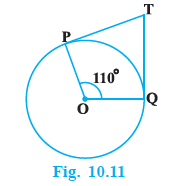
$60^{\circ}$
b.$70^{\circ}$
c.$80^{\circ}$
d.$90^{\circ}$
Choose the correct option and give justification. If tangents $PA$ and $PB$ from a point $P$ to a circle with centre $O$ are inclined to each other at angle of $80^{\circ}$, then $\angle POA$ is equal to
$50^{\circ}$
b.$60^{\circ}$
c.$70^{\circ}$
d.$80^{\circ}$
A tangent $PQ$ at a point $P$ of a circle of radius $5$ cm meets a line through the centre $O$ at a point $Q$ so that $OQ = 12$ cm. Length $PQ$ is :
12 cm
b.13 cm
c.8.5 cm
d.$\sqrt{119}$ cm.
Choose the correct option and give justification. From a point $Q$, the length of the tangent to a circle is $24$ cm and the distance of $Q$ from the centre is $25$ cm. The radius of the circle is
7 cm
b.12 cm
c.15 cm
d.24.5 cm
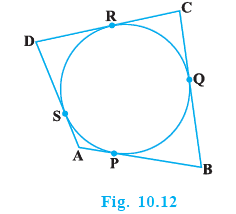
A quadrilateral $ABCD$ is drawn to circumscribe a circle (see Fig. 10.12). Prove that $AB + CD = AD + BC$.
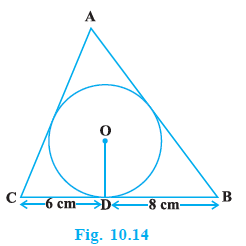
A triangle $ABC$ is drawn to circumscribe a circle of radius $4$ cm such that the segments $BD$ and $DC$ into which $BC$ is divided by the point of contact $D$ are of lengths $8$ cm and $6$ cm respectively (see Fig. 10.14). Find the sides $AB$ and $AC$.
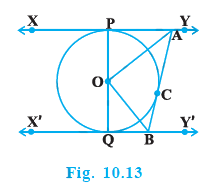
In Fig. 10.13, $XY$ and $X'Y'$ are two parallel tangents to a circle with centre $O$ and another tangent $AB$ with point of contact $C$ intersecting $XY$ at $A$ and $X'Y'$ at $B$. Prove that $\angle AOB = 90^{\circ}$.
Worksheet Answers
Solution:
Given: A circle and a line segment defined as a tangent to that circle.
To Find: The number of points at which a tangent intersects the circle.
Step 1: Defining a Tangent
By definition, a tangent to a circle is a line that touches the circle at exactly one point. This point is known as the "point of contact" or "point of tangency."
Step 2: Analyzing the Intersection
Let the circle be denoted by $C$ with center $O$ and radius $r$. Let the line be $L$.
If the line $L$ were to intersect the circle at two distinct points, it would be classified as a secant line.
If the line $L$ were to not intersect the circle at all, it would be a non-intersecting line.
Since the line is defined as a tangent, it must satisfy the condition of having exactly one common point with the circumference of the circle.
Step 3: Conclusion
Based on the geometric definition of a tangent in Euclidean geometry, the number of points of intersection is exactly one.
Final Answer: A tangent to a circle intersects it in one point(s).
Solution:
Given: A quadrilateral $ABCD$ circumscribing a circle with center $O$. The sides $AB, BC, CD,$ and $DA$ touch the circle at points $P, Q, R,$ and $S$ respectively.
To Prove: The opposite sides subtend supplementary angles at the center $O$. That is, $\angle AOB + \angle COD = 180^\circ$ and $\angle BOC + \angle DOA = 180^\circ$.
Step 1: Joining the points of contact to the center.
Join the center $O$ to the points of contact $P, Q, R,$ and $S$. Also, join $OA, OB, OC,$ and $OD$.
Step 2: Identifying congruent triangles.
Consider $\triangle OAP$ and $\triangle OAS$:
Step 3: Applying the same logic to other pairs.
Similarly, we can prove:
Step 4: Summing the angles around the center.
The sum of all angles around the center $O$ is $360^\circ$:
$\angle 1 + \angle 2 + \angle 3 + \angle 4 + \angle 5 + \angle 6 + \angle 7 + \angle 8 = 360^\circ$
Step 5: Substituting the equal angles.
Since $\angle 1 = \angle 2$, $\angle 3 = \angle 4$, $\angle 5 = \angle 6$, and $\angle 7 = \angle 8$, we substitute these into the equation:
$2\angle 2 + 2\angle 3 + 2\angle 6 + 2\angle 7 = 360^\circ$
Dividing by 2:
$\angle 2 + \angle 3 + \angle 6 + \angle 7 = 180^\circ$
Step 6: Grouping the angles.
Rearranging the terms:
$(\angle 2 + \angle 3) + (\angle 6 + \angle 7) = 180^\circ$
From the figure, $\angle 2 + \angle 3 = \angle AOB$ and $\angle 6 + \angle 7 = \angle COD$.
Thus, $\angle AOB + \angle COD = 180^\circ$.
Similarly, it can be shown that $\angle BOC + \angle DOA = 180^\circ$.
Final Answer: The opposite sides of the quadrilateral subtend supplementary angles at the center of the circle, as $\angle AOB + \angle COD = 180^\circ$ and $\angle BOC + \angle DOA = 180^\circ$.
Solution:
Given: A circle in a two-dimensional Euclidean plane.
To Find: The total number of tangents that can be drawn to a circle.
Step 1: Defining a Tangent
A tangent to a circle is defined as a line that intersects the circle at exactly one point. This point is known as the point of contact. [Definition: A tangent is a line that touches the circle at a single point and does not enter the interior of the circle.]
Step 2: Analyzing the Circumference
A circle is defined as the locus of all points in a plane that are at a fixed distance (the radius) from a fixed point (the center). The circumference of a circle consists of an infinite number of distinct points.
Step 3: Establishing the Correspondence
Since every point on the circumference of the circle can serve as a point of contact for a unique tangent line, we must determine the number of points on the circumference. [Axiom: A circle is composed of an infinite set of points.]
Step 4: Logical Deduction
1. Let $P$ be any arbitrary point on the circumference of the circle.
2. Through point $P$, exactly one tangent line can be drawn such that it is perpendicular to the radius at that point. [Theorem: The tangent at any point of a circle is perpendicular to the radius through the point of contact.]
3. Because there are infinitely many points $P_1, P_2, P_3, \dots, P_n$ on the circumference of the circle, there exist infinitely many corresponding tangent lines.
Conclusion:
As the number of points on the circumference is infinite, the number of tangents that can be drawn to a circle is also infinite.
Final Answer: A circle can have infinitely many tangents.
Solution:
Given: A circle with center $O$. Let $AB$ be a diameter of the circle. Let $PQ$ be a tangent at point $A$ and $RS$ be a tangent at point $B$.
To Prove: $PQ \parallel RS$.
Step 1: Applying the Tangent-Radius Theorem
According to the theorem: "The tangent at any point of a circle is perpendicular to the radius through the point of contact."
Since $PQ$ is a tangent at $A$ and $OA$ is the radius, we have:
$OA \perp PQ \implies \angle OAP = 90^\circ$ and $\angle OAQ = 90^\circ$.
Similarly, since $RS$ is a tangent at $B$ and $OB$ is the radius, we have:
$OB \perp RS \implies \angle OBR = 90^\circ$ and $\angle OBS = 90^\circ$.
Step 2: Analyzing the Angles
Consider the lines $PQ$ and $RS$ intersected by the transversal $AB$.
From Step 1, we have:
$\angle OAP = 90^\circ$
$\angle OBS = 90^\circ$
Therefore, $\angle OAP = \angle OBS = 90^\circ$.
Step 3: Establishing Parallelism
Observe that $\angle OAP$ and $\angle OBS$ are alternate interior angles with respect to lines $PQ$ and $RS$ and transversal $AB$.
[Theorem: If a transversal intersects two lines such that a pair of alternate interior angles are equal, then the two lines are parallel.]
Since $\angle OAP = \angle OBS = 90^\circ$, the alternate interior angles are equal.
Thus, $PQ \parallel RS$.
Final Answer: Since the alternate interior angles formed by the transversal $AB$ with lines $PQ$ and $RS$ are equal ($90^\circ$), the tangents $PQ$ and $RS$ are parallel to each other.
Solution:
Given: A circle and a tangent line that intersects the circle at exactly one point.
To Find: The specific mathematical term used to describe the common point where the tangent line meets the circle.
Step 1: Understanding the Geometry of a Tangent
By definition, a tangent to a circle is a line that intersects the circle at exactly one point. This point is unique because it is the only location on the circumference of the circle that lies on the tangent line.
Step 2: Defining the Terminology
In Euclidean geometry, when a line touches a curve (in this case, a circle) at a single point, that point is referred to as the "point of contact" or the "point of tangency."
Step 3: Logical Deduction
Since the question asks for the name of the common point between the tangent and the circle, we apply the standard geometric definition:
Final Answer: The common point of a tangent to a circle and the circle is called the point of contact (or point of tangency).
Solution:
Given: A circle in a two-dimensional Euclidean plane.
To Find: The maximum number of parallel tangents that a circle can have.
Visual Representation:
Step 1: Understanding the definition of a tangent
A tangent to a circle is a line that intersects the circle at exactly one point. By the property of circles, a tangent at any point of a circle is perpendicular to the radius through the point of contact.
Step 2: Analyzing parallel lines in relation to a circle
Let $L_1$ be a tangent to the circle at point $P$. Let $O$ be the center of the circle. By the tangent-radius theorem, the radius $OP$ is perpendicular to $L_1$ ($OP \perp L_1$).
Step 3: Determining the existence of a parallel tangent
If we draw a line $L_2$ parallel to $L_1$, for $L_2$ to also be a tangent, it must be perpendicular to the same radius $OP$ at a different point. The only point on the circle that lies on the line passing through $O$ and $P$ other than $P$ is the point $Q$, which is the other end of the diameter passing through $P$.
Step 4: Logical Deduction
Since a diameter is a straight line passing through the center, the tangents drawn at the two endpoints of a diameter are always parallel to each other. If we attempt to draw a third tangent $L_3$ parallel to $L_1$ and $L_2$, it would have to be perpendicular to the diameter $PQ$. However, there are no other points on the circle where a tangent can be drawn that is perpendicular to the diameter $PQ$ other than the points $P$ and $Q$ themselves.
Conclusion:
A circle can have only two tangents that are parallel to each other, specifically those drawn at the opposite ends of any diameter.
Final Answer: A circle can have 2 parallel tangents at the most.
Solution:
Given: A circle with center $O$ and a reference line $L$.
To Find: Construct two lines, $L_1$ and $L_2$, such that $L_1 \parallel L \parallel L_2$, where $L_1$ is a tangent to the circle and $L_2$ is a secant to the circle.
Visual Representation:
Step 1: Understanding the Definitions
A tangent to a circle is a line that intersects the circle at exactly one point. A secant to a circle is a line that intersects the circle at two distinct points.
Step 2: Constructing the Tangent ($L_1$)
To draw a line $L_1$ parallel to $L$ that is a tangent to the circle:
1. Identify the diameter of the circle that is perpendicular to the reference line $L$. Let this diameter be $AB$.
2. Since $L_1$ must be parallel to $L$, and $L$ is perpendicular to the diameter $AB$, $L_1$ must also be perpendicular to the diameter $AB$ [By the property: If two lines are parallel, any line perpendicular to one is perpendicular to the other].
3. Draw a line passing through point $A$ (an endpoint of the diameter) perpendicular to $AB$. This line $L_1$ touches the circle at exactly one point $A$ and is parallel to $L$.
Step 3: Constructing the Secant ($L_2$)
To draw a line $L_2$ parallel to $L$ that is a secant to the circle:
1. Choose any point $P$ on the diameter $AB$ such that $P$ lies between the center $O$ and the point $B$ (where $B$ is the endpoint of the diameter closest to the reference line $L$).
2. Draw a line $L_2$ passing through point $P$ such that $L_2$ is perpendicular to the diameter $AB$.
3. Since $L_2$ is perpendicular to the diameter $AB$ and $L_1$ is also perpendicular to $AB$, it follows that $L_1 \parallel L_2$ [Since lines perpendicular to the same line are parallel to each other].
4. Because the distance from the center $O$ to the line $L_2$ is less than the radius of the circle, the line $L_2$ must intersect the circle at two distinct points, thereby satisfying the definition of a secant.
Final Answer: The lines $L_1$ and $L_2$ are constructed by drawing lines perpendicular to the diameter of the circle that is itself perpendicular to the reference line $L$, ensuring $L_1$ is tangent at the circle's boundary and $L_2$ passes through the interior of the circle.
Solution:
Given:
A circle with centre $O$. $TP$ and $TQ$ are two tangents drawn from an external point $T$ to the circle. The angle between the radii at the points of contact is $\angle POQ = 110^{\circ}$.
To Find:
The measure of $\angle PTQ$.
Visual Representation:
Step 1: Identifying Geometric Properties
According to the theorem: "The tangent at any point of a circle is perpendicular to the radius through the point of contact."
Therefore, $OP \perp TP$ and $OQ \perp TQ$.
This implies that $\angle OPT = 90^{\circ}$ and $\angle OQT = 90^{\circ}$.
Step 2: Analyzing the Quadrilateral
Consider the quadrilateral $OPTQ$. The sum of the interior angles of a quadrilateral is always $360^{\circ}$.
The sum of the angles is given by:
$\angle POQ + \angle OPT + \angle PTQ + \angle OQT = 360^{\circ}$
Step 3: Substituting Known Values
Substitute the known values into the equation:
$110^{\circ} + 90^{\circ} + \angle PTQ + 90^{\circ} = 360^{\circ}$
Step 4: Solving for $\angle PTQ$
Combine the constant terms:
$110^{\circ} + 180^{\circ} + \angle PTQ = 360^{\circ}$
$290^{\circ} + \angle PTQ = 360^{\circ}$
Subtract $290^{\circ}$ from both sides:
$\angle PTQ = 360^{\circ} - 290^{\circ}$
$\angle PTQ = 70^{\circ}$
Final Answer: The measure of $\angle PTQ$ is $70^{\circ}$.
Solution:
Given:
1. A circle with center $O$.
2. Two tangents $PA$ and $PB$ drawn from an external point $P$ to the circle.
3. The angle between the tangents, $\angle APB = 80^{\circ}$.
To Find:
The measure of $\angle POA$.
Step 1: Analyzing the Geometry of the Quadrilateral
Consider the quadrilateral $OAPB$. In this figure:
1. $OA \perp PA$ [Since the tangent at any point of a circle is perpendicular to the radius through the point of contact]. Thus, $\angle OAP = 90^{\circ}$.
2. $OB \perp PB$ [Since the tangent at any point of a circle is perpendicular to the radius through the point of contact]. Thus, $\angle OBP = 90^{\circ}$.
Step 2: Calculating the sum of angles in the quadrilateral
The sum of the interior angles of a quadrilateral is $360^{\circ}$.
$\angle OAP + \angle OBP + \angle APB + \angle AOB = 360^{\circ}$
Substituting the known values:
$90^{\circ} + 90^{\circ} + 80^{\circ} + \angle AOB = 360^{\circ}$
$260^{\circ} + \angle AOB = 360^{\circ}$
$\angle AOB = 360^{\circ} - 260^{\circ} = 100^{\circ}$
Step 3: Using Congruency to find $\angle POA$
Consider $\triangle OAP$ and $\triangle OBP$:
1. $OA = OB$ (Radii of the same circle)
2. $OP = OP$ (Common side)
3. $PA = PB$ (Tangents drawn from an external point to a circle are equal in length)
By SSS congruency criterion, $\triangle OAP \cong \triangle OBP$.
By CPCT (Corresponding Parts of Congruent Triangles), $\angle POA = \angle POB$.
Since $\angle AOB = \angle POA + \angle POB$, we have:
$\angle AOB = 2 \times \angle POA$
$100^{\circ} = 2 \times \angle POA$
$\angle POA = \frac{100^{\circ}}{2} = 50^{\circ}$
Final Answer: The value of $\angle POA$ is $50^{\circ}$.
Solution:
Given:
To find:
The length of the tangent $PQ$.
Step 1: Identifying the geometric relationship
According to the Theorem 10.1 of circles: "The tangent at any point of a circle is perpendicular to the radius through the point of contact."
Therefore, $OP \perp PQ$. This implies that $\angle OPQ = 90^\circ$.
Step 2: Applying the Pythagorean Theorem
Since $\triangle OPQ$ is a right-angled triangle with the right angle at $P$, we can apply the Pythagorean Theorem, which states that in a right-angled triangle, the square of the hypotenuse is equal to the sum of the squares of the other two sides.
In $\triangle OPQ$:
$OQ^2 = OP^2 + PQ^2$
Step 3: Substituting the known values
Given $OP = 5$ cm and $OQ = 12$ cm, we substitute these into the equation:
$(12)^2 = (5)^2 + PQ^2$
$144 = 25 + PQ^2$
Step 4: Solving for $PQ$
Subtract $25$ from both sides of the equation:
$PQ^2 = 144 - 25$
$PQ^2 = 119$
Taking the square root of both sides:
$PQ = \sqrt{119}$ cm
Final Answer: The length of the tangent $PQ$ is $\sqrt{119}$ cm.
Solution:
Given:
A circle with center $O$. A point $Q$ lies outside the circle such that the distance from the center $O$ to point $Q$ is $OQ = 25$ cm. A tangent is drawn from $Q$ to the circle, touching the circle at point $P$, such that the length of the tangent $QP = 24$ cm.
To Find:
The radius of the circle, denoted as $OP$.
Step 1: Applying the Tangent-Radius Theorem
According to the theorem: "The tangent at any point of a circle is perpendicular to the radius through the point of contact."
Therefore, $OP \perp QP$. This implies that $\angle OPQ = 90^\circ$.
Step 2: Identifying the Triangle
Since $\angle OPQ = 90^\circ$, the triangle $\triangle OPQ$ is a right-angled triangle, where $OQ$ is the hypotenuse, and $OP$ and $QP$ are the legs of the triangle.
Step 3: Applying the Pythagorean Theorem
In a right-angled triangle, the square of the hypotenuse is equal to the sum of the squares of the other two sides. [Pythagorean Theorem: $a^2 + b^2 = c^2$]
Substituting the known values into the equation:
$OP^2 + QP^2 = OQ^2$
$OP^2 + (24)^2 = (25)^2$
Step 4: Algebraic Calculation
Calculate the squares of the given lengths:
$OP^2 + 576 = 625$
Isolate $OP^2$ by subtracting 576 from both sides:
$OP^2 = 625 - 576$
$OP^2 = 49$
Take the square root of both sides:
$OP = \sqrt{49}$
$OP = 7$ cm
Conclusion:
The radius of the circle $OP$ is $7$ cm.
Final Answer: 7 cm
Solution:
Given:
Two concentric circles with a common center $O$.
Radius of the larger circle, $R = 5$ cm.
Radius of the smaller circle, $r = 3$ cm.
A chord $AB$ of the larger circle touches the smaller circle at point $P$.
To Find:
The length of the chord $AB$.
Step 1: Establishing Geometric Relationships
Let $O$ be the center of the concentric circles. Let $AB$ be the chord of the larger circle that is tangent to the smaller circle at point $P$.
By the property of tangents: A tangent at any point of a circle is perpendicular to the radius through the point of contact. Therefore, $OP \perp AB$. [Theorem: The tangent at any point of a circle is perpendicular to the radius through the point of contact.]
Step 2: Applying the Perpendicular Bisector Theorem
In the larger circle, $OP$ is a line segment from the center $O$ perpendicular to the chord $AB$.
According to the theorem: A perpendicular drawn from the center of a circle to a chord bisects the chord. [Theorem: The perpendicular from the center of a circle to a chord bisects the chord.]
Therefore, $AP = PB$.
Step 3: Calculating the Length of $AP$ using the Pythagorean Theorem
Consider the right-angled triangle $\triangle OPA$, where $\angle OPA = 90^\circ$.
Using the Pythagorean Theorem: $OA^2 = OP^2 + AP^2$.
Given $OA = R = 5$ cm and $OP = r = 3$ cm.
$5^2 = 3^2 + AP^2$
$25 = 9 + AP^2$
$AP^2 = 25 - 9$
$AP^2 = 16$
$AP = \sqrt{16} = 4$ cm.
Step 4: Determining the Total Length of the Chord $AB$
Since $AP = PB$ and $AP = 4$ cm, then $PB = 4$ cm.
The total length of the chord $AB = AP + PB$.
$AB = 4 \text{ cm} + 4 \text{ cm} = 8 \text{ cm}$.
Final Answer: The length of the chord of the larger circle is 8 cm.
Solution:
Given: A quadrilateral $ABCD$ circumscribing a circle with center $O$. The circle touches the sides $AB$, $BC$, $CD$, and $DA$ at points $P$, $Q$, $R$, and $S$ respectively.
To Prove: $AB + CD = AD + BC$
Step 1: Applying the Tangent Theorem
We use the theorem: The lengths of tangents drawn from an external point to a circle are equal.
Considering the external points $A, B, C,$ and $D$:
1. From point $A$: $AP = AS$ --- (Equation 1)
2. From point $B$: $BP = BQ$ --- (Equation 2)
3. From point $C$: $CQ = CR$ --- (Equation 3)
4. From point $D$: $DR = DS$ --- (Equation 4)
Step 2: Summing the Equations
Adding Equations 1, 2, 3, and 4 together:
$AP + BP + CQ + DR = AS + BQ + CR + DS$
Step 3: Rearranging the Terms
Group the segments that form the sides of the quadrilateral:
$(AP + BP) + (CQ + DR) = (AS + DS) + (BQ + CR)$
Step 4: Substituting Side Lengths
Based on the geometry of the quadrilateral:
$AP + BP = AB$
$CQ + DR = CD$
$AS + DS = AD$
$BQ + CR = BC$
Substituting these into the equation from Step 3:
$AB + CD = AD + BC$
Conclusion:
Since the sum of the lengths of opposite sides is equal, the identity is proven.
Final Answer: Hence, it is proved that $AB + CD = AD + BC$.
Solution:
Given:
A circle with center $O$ and radius $r = 4$ cm is inscribed in $\triangle ABC$. The circle touches the sides $BC$, $AC$, and $AB$ at points $D$, $E$, and $F$ respectively. The segments $BD = 8$ cm and $DC = 6$ cm.
To Find:
The lengths of sides $AB$ and $AC$.
Step 1: Applying the Tangent Properties
According to the theorem: "The lengths of tangents drawn from an external point to a circle are equal."
Let $AF = AE = x$ cm.
Since $BD = 8$ cm, then $BF = BD = 8$ cm.
Since $DC = 6$ cm, then $CE = DC = 6$ cm.
Therefore, the sides of the triangle are:
$BC = BD + DC = 8 + 6 = 14$ cm
$AB = AF + FB = x + 8$ cm
$AC = AE + EC = x + 6$ cm
Step 2: Calculating the Area of $\triangle ABC$ using Heron's Formula
The semi-perimeter $s$ is given by:
$s = \frac{AB + BC + AC}{2} = \frac{(x + 8) + 14 + (x + 6)}{2} = \frac{2x + 28}{2} = x + 14$
Area of $\triangle ABC = \sqrt{s(s-a)(s-b)(s-c)}$
Area $= \sqrt{(x+14)(x+14 - 14)(x+14 - (x+6))(x+14 - (x+8))}$
Area $= \sqrt{(x+14)(x)(8)(6)} = \sqrt{48x(x+14)}$
Step 3: Calculating the Area using the Incenter Method
The area of $\triangle ABC$ is the sum of the areas of $\triangle OBC$, $\triangle OCA$, and $\triangle OAB$.
Area $= \text{Area}(\triangle OBC) + \text{Area}(\triangle OCA) + \text{Area}(\triangle OAB)$
Area $= \frac{1}{2} \times BC \times r + \frac{1}{2} \times AC \times r + \frac{1}{2} \times AB \times r$
Area $= \frac{1}{2} \times 4 \times (14 + x + 6 + x + 8) = 2 \times (2x + 28) = 4(x + 14)$
Step 4: Equating the Areas and Solving for $x$
$\sqrt{48x(x+14)} = 4(x+14)$
Squaring both sides:
$48x(x+14) = 16(x+14)^2$
Divide both sides by $16(x+14)$ (since $x+14 \neq 0$):
$3x = x + 14$
$2x = 14 \implies x = 7$
Step 5: Determining Final Side Lengths
$AB = x + 8 = 7 + 8 = 15$ cm
$AC = x + 6 = 7 + 6 = 13$ cm
Final Answer: The sides are $AB = 15$ cm and $AC = 13$ cm.
Solution:
Given: A circle with center $O$. Let $XY$ be a tangent to the circle at the point of contact $P$.
To Prove: The perpendicular to the tangent $XY$ at the point of contact $P$ passes through the center $O$.
Step 1: Assumption for Proof by Contradiction
Let us assume that the perpendicular to the tangent $XY$ at point $P$ does not pass through the center $O$. Instead, let it pass through another point $O'$ such that $O'P \perp XY$.
Step 2: Utilizing the Tangent-Radius Theorem
We know from the theorem: "The tangent at any point of a circle is perpendicular to the radius through the point of contact."
Therefore, the radius $OP$ must be perpendicular to the tangent $XY$.
Mathematically, $OP \perp XY$.
This implies that $\angle OPX = 90^\circ$. [Since $OP$ is the radius at point of contact $P$]
Step 3: Analyzing the Assumption
By our initial assumption in Step 1, we stated that $O'P \perp XY$.
This implies that $\angle O'PX = 90^\circ$.
Step 4: Logical Deduction
Comparing the results from Step 2 and Step 3:
$\angle OPX = 90^\circ$
$\angle O'PX = 90^\circ$
Therefore, $\angle OPX = \angle O'PX$.
Step 5: Conclusion
The equality $\angle OPX = \angle O'PX$ is only possible if the line $O'P$ coincides with the line $OP$.
This means that the point $O'$ must be the same as point $O$.
Thus, our assumption that the perpendicular does not pass through the center is false.
Final Answer: Hence, it is proved that the perpendicular at the point of contact to the tangent to a circle must pass through the center.
Solution:
Given: A parallelogram $ABCD$ circumscribing a circle with center $O$. The sides $AB$, $BC$, $CD$, and $DA$ touch the circle at points $P$, $Q$, $R$, and $S$ respectively.
To Prove: Parallelogram $ABCD$ is a rhombus (i.e., $AB = BC = CD = DA$).
Step 1: Applying the Tangent Theorem
We know that the lengths of tangents drawn from an external point to a circle are equal. [Theorem: Tangents from an external point to a circle are equal in length.]
From point $A$: $AP = AS$ --- (i)
From point $B$: $BP = BQ$ --- (ii)
From point $C$: $CQ = CR$ --- (iii)
From point $D$: $DR = DS$ --- (iv)
Step 2: Summing the Equations
Adding equations (i), (ii), (iii), and (iv):
$(AP + BP) + (CQ + DR) = (AS + DS) + (BQ + CQ)$
Rearranging the terms based on the sides of the parallelogram:
$(AP + BP) + (CQ + DR) = (AS + DS) + (BQ + CQ)$
$AB + CD = AD + BC$ --- (v)
Step 3: Utilizing Parallelogram Properties
Since $ABCD$ is a parallelogram, we know that opposite sides are equal:
$AB = CD$ and $BC = AD$ [Property of a parallelogram]
Step 4: Substitution and Simplification
Substitute $CD = AB$ and $AD = BC$ into equation (v):
$AB + AB = BC + BC$
$2AB = 2BC$
$AB = BC$
Step 5: Conclusion
Since $AB = BC$ and we already know $AB = CD$ and $BC = AD$ (opposite sides of a parallelogram), it follows that:
$AB = BC = CD = DA$.
A parallelogram with all sides equal is defined as a rhombus. Therefore, $ABCD$ is a rhombus.
Final Answer: Since all sides of the parallelogram $ABCD$ are equal ($AB = BC = CD = DA$), the parallelogram is proven to be a rhombus.
Solution:
Given:
1. A circle with center $O$.
2. A point $A$ outside the circle such that the distance from the center $O$ to point $A$ is $OA = 5$ cm.
3. A tangent $AB$ from point $A$ to the circle at point $B$, where the length of the tangent $AB = 4$ cm.
To find:
The radius of the circle, denoted as $OB$.
Step 1: Applying the Tangent-Radius Theorem
According to the theorem: "The tangent at any point of a circle is perpendicular to the radius through the point of contact."
Therefore, $OB \perp AB$. This implies that $\angle OBA = 90^\circ$.
Step 2: Identifying the Geometric Figure
Since $\angle OBA = 90^\circ$, the triangle $\triangle OBA$ is a right-angled triangle, where $OA$ is the hypotenuse, $OB$ is the radius (base/height), and $AB$ is the tangent.
Step 3: Applying the Pythagorean Theorem
In a right-angled triangle, the square of the hypotenuse is equal to the sum of the squares of the other two sides. [Using Pythagoras Theorem: $Hypotenuse^2 = Base^2 + Height^2$]
$OA^2 = OB^2 + AB^2$
Step 4: Substituting the Given Values
Given $OA = 5$ cm and $AB = 4$ cm.
$(5)^2 = OB^2 + (4)^2$
Step 5: Solving for the Radius ($OB$)
$25 = OB^2 + 16$
Subtract 16 from both sides:
$OB^2 = 25 - 16$
$OB^2 = 9$
Taking the square root on both sides:
$OB = \sqrt{9}$
$OB = 3$ cm
[Since length cannot be negative, we take the positive root.]
Final Answer: The radius of the circle is 3 cm.
Solution:
Given: A circle with center $O$. An external point $P$ from which two tangents $PA$ and $PB$ are drawn to the circle, touching the circle at points $A$ and $B$ respectively. The line segment $AB$ joins the points of contact.
To Prove: $\angle APB + \angle AOB = 180^\circ$ (i.e., they are supplementary).
Step 1: Identify the properties of tangents to a circle.
According to the theorem: "The tangent at any point of a circle is perpendicular to the radius through the point of contact."
Therefore, $OA \perp PA$ and $OB \perp PB$.
This implies that $\angle OAP = 90^\circ$ and $\angle OBP = 90^\circ$.
Step 2: Consider the quadrilateral $OAPB$.
In the quadrilateral $OAPB$, the sum of the interior angles is given by the angle sum property of a quadrilateral.
$\angle OAP + \angle APB + \angle OBP + \angle AOB = 360^\circ$ [Sum of interior angles of a quadrilateral is $360^\circ$].
Step 3: Substitute the known values into the equation.
Substitute $\angle OAP = 90^\circ$ and $\angle OBP = 90^\circ$ into the equation:
$90^\circ + \angle APB + 90^\circ + \angle AOB = 360^\circ$
Step 4: Simplify the algebraic expression.
Combine the constant terms:
$180^\circ + \angle APB + \angle AOB = 360^\circ$
Subtract $180^\circ$ from both sides of the equation:
$\angle APB + \angle AOB = 360^\circ - 180^\circ$
$\angle APB + \angle AOB = 180^\circ$
Conclusion:
Since the sum of $\angle APB$ and $\angle AOB$ is $180^\circ$, the angle between the two tangents and the angle subtended by the line segment joining the points of contact at the center are supplementary.
Final Answer: Hence, it is proved that $\angle APB + \angle AOB = 180^\circ$.
Solution:
Given:
1. A circle with center $O$.
2. Two parallel tangents $XY$ and $X'Y'$ touching the circle at points $P$ and $Q$ respectively.
3. A third tangent $AB$ touching the circle at point $C$, intersecting $XY$ at $A$ and $X'Y'$ at $B$.
To Prove:
$\angle AOB = 90^{\circ}$
Step 1: Construction and Identification of Congruent Triangles
Join $OC$. Consider $\triangle OPA$ and $\triangle OCA$.
In $\triangle OPA$ and $\triangle OCA$:
$OP = OC$ [Radii of the same circle]
$OA = OA$ [Common side]
$AP = AC$ [Tangents drawn from an external point $A$ to the circle are equal in length]
Therefore, $\triangle OPA \cong \triangle OCA$ [By SSS Congruence Criterion].
Consequently, $\angle POA = \angle COA$ (Equation 1) [By CPCT - Corresponding Parts of Congruent Triangles].
Step 2: Applying Congruence to the Second Set of Triangles
Similarly, consider $\triangle OQB$ and $\triangle OCB$.
In $\triangle OQB$ and $\triangle OCB$:
$OQ = OC$ [Radii of the same circle]
$OB = OB$ [Common side]
$BQ = BC$ [Tangents drawn from an external point $B$ to the circle are equal in length]
Therefore, $\triangle OQB \cong \triangle OCB$ [By SSS Congruence Criterion].
Consequently, $\angle QOB = \angle COB$ (Equation 2) [By CPCT].
Step 3: Summing the Angles on the Straight Line
$PQ$ is a diameter of the circle because $XY \parallel X'Y'$ and the tangents are perpendicular to the diameter at the points of contact. Thus, $POQ$ is a straight line.
The sum of all angles formed at the center $O$ on the straight line $PQ$ is $180^{\circ}$:
$\angle POA + \angle COA + \angle COB + \angle QOB = 180^{\circ}$
Step 4: Substitution and Final Calculation
Using Equation 1 ($\angle POA = \angle COA$) and Equation 2 ($\angle QOB = \angle COB$):
$\angle COA + \angle COA + \angle COB + \angle COB = 180^{\circ}$
$2\angle COA + 2\angle COB = 180^{\circ}$
$2(\angle COA + \angle COB) = 180^{\circ}$
$\angle COA + \angle COB = \frac{180^{\circ}}{2}$
$\angle AOB = 90^{\circ}$ [Since $\angle COA + \angle COB = \angle AOB$]
Final Answer: $\angle AOB = 90^{\circ}$
Solution:
Given: A circle and a line that intersects the circle at two distinct points.
To Find: The specific mathematical term used to describe such a line.
Step 1: Analyzing the definition of a line intersecting a circle
In geometry, the relationship between a line and a circle is categorized based on the number of points of intersection:
1. If a line does not touch the circle at all, it is called a non-intersecting line.
2. If a line touches the circle at exactly one point, it is called a tangent.
3. If a line intersects the circle at two distinct points, it is called a secant.
Step 2: Applying the definition
The problem states that the line intersects the circle in two points. By the standard definition in Euclidean geometry, a line that cuts through a circle at two points is defined as a secant line.
Step 3: Conclusion
Since the line passes through the interior of the circle and intersects the circumference at two distinct points, the term that satisfies the condition is "secant".
Final Answer: A line intersecting a circle in two points is called a secant.


