


Your Worksheet is Ready
CBSE - Class 10 Mathematics Areas Related to Circles Worksheet
If the perimeter of a circle is equal to that of a square, then the ratio of their areas is
22 : 7
b.14 : 11
c.7 : 22
d.11: 14
If the sum of the areas of two circles with radii R1 and R2 is equal to the area of a circle of radius R, then
R1 + R2= R
b.R21 + R22= R2
c.R1 + R2< R
d.R21 + R22< R2
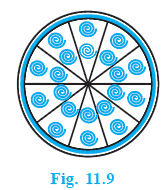
A brooch is made with silver wire in the form of a circle with diameter 35 mm. The wire is also used in making 5 diameters which divide the circle into 10 equal sectors as shown in Fig. 11.9. Find : (ii) the area of each sector of the brooch. (Unless stated otherwise, use $\pi = \frac{22}{7}$)
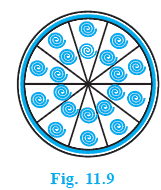
If the sum of the circumferences of two circles with radii R1 and R2 is equal to the circumference of a circle of radius R, then
R1 + R2 = R
b.R1 + R2 > R
c.R1 + R2 < R
d.Nothing definite can be said about the relation among R1, R2 and R
Area of the largest triangle that can be inscribed in a semi-circle of radius r units is
r2 sq. units
b.½ r2 sq. units
c.2 r2 sq. units
d.√2 r2 sq. units
If the sum of the areas of two circles with radii R1 and R2 is equal to the area of a circle of radius R, then
R1 + R2 = R
b.R1² + R2² = R²
c.R1 + R2 < R
d.R1² + R2² < R²
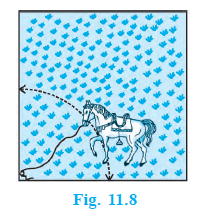
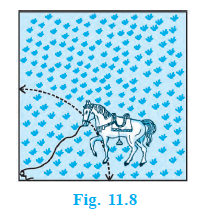
A horse is tied to a peg at one corner of a square shaped grass field of side 15 m by means of a 5 m long rope (see Fig. 11.8). Find (ii) the increase in the grazing area if the rope were 10 m long instead of 5 m. (Use $\pi = 3.14$)
A brooch is made with silver wire in the form of a circle with diameter 35 mm. The wire is also used in making 5 diameters which divide the circle into 10 equal sectors as shown in Fig. 11.9. Find : (i) the total length of the silver wire required. (Unless stated otherwise, use $\pi = \frac{22}{7}$)
A horse is tied to a peg at one corner of a square shaped grass field of side 15 m by means of a 5 m long rope (see Fig. 11.8). Find (i) the area of that part of the field in which the horse can graze. (Use $\pi = 3.14$)
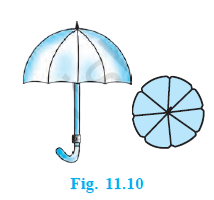
An umbrella has 8 ribs which are equally spaced (see Fig. 11.10). Assuming umbrella to be a flat circle of radius 45 cm, find the area between the two consecutive ribs of the umbrella. (Unless stated otherwise, use $\pi = \frac{22}{7}$)
The diameter of a circle whose area is equal to the sum of the areas of the two circles of radii 24 cm and 7 cm is
31 cm
b.25 cm
c.62 cm
d.50 cm
Worksheet Answers
Solution:
Given:
Radius of the circle ($r$) = $15\text{ cm}$
Angle subtended by the chord at the centre ($\theta$) = $60^\circ$
Constants: $\pi = 3.14$, $\sqrt{3} = 1.73$
To Find:
1. Area of the minor segment.
2. Area of the major segment.
Step 1: Calculate the Area of the Sector
The formula for the area of a sector is: $A_{sector} = \frac{\theta}{360^\circ} \times \pi r^2$
$A_{sector} = \frac{60}{360} \times 3.14 \times (15)^2$
$A_{sector} = \frac{1}{6} \times 3.14 \times 225$
$A_{sector} = \frac{706.5}{6} = 117.75\text{ cm}^2$
Step 2: Calculate the Area of the Triangle (OAB)
Since the angle at the centre is $60^\circ$ and the two sides are radii ($OA = OB = 15\text{ cm}$), the triangle is equilateral. The area of an equilateral triangle is given by: $A_{triangle} = \frac{\sqrt{3}}{4} \times r^2$
$A_{triangle} = \frac{1.73}{4} \times (15)^2$
$A_{triangle} = \frac{1.73}{4} \times 225$
$A_{triangle} = \frac{389.25}{4} = 97.3125\text{ cm}^2$
Step 3: Calculate the Area of the Minor Segment
The area of the minor segment is the difference between the area of the sector and the area of the triangle.
$A_{minor\_segment} = A_{sector} - A_{triangle}$
$A_{minor\_segment} = 117.75 - 97.3125 = 20.4375\text{ cm}^2$
Step 4: Calculate the Area of the Major Segment
The area of the major segment is the total area of the circle minus the area of the minor segment.
$A_{circle} = \pi r^2 = 3.14 \times (15)^2 = 3.14 \times 225 = 706.5\text{ cm}^2$
$A_{major\_segment} = A_{circle} - A_{minor\_segment}$
$A_{major\_segment} = 706.5 - 20.4375 = 686.0625\text{ cm}^2$
Final Answer: The area of the minor segment is 20.4375 cm² and the area of the major segment is 686.0625 cm².
Solution:
Given:
1. The brooch is circular in shape.
2. The diameter of the circle ($d$) = $35\text{ mm}$.
3. The wire is used to form the circumference and 5 diameters.
4. The 5 diameters divide the circle into 10 equal sectors.
To Find:
The area of each sector of the brooch.
Step 1: Determine the radius of the circle.
The radius ($r$) is half of the diameter ($d$).
$r = \frac{d}{2}$
$r = \frac{35}{2}\text{ mm} = 17.5\text{ mm}$
Step 2: Determine the area of the entire circle.
The formula for the area of a circle is $A = \pi r^2$.
Using $\pi = \frac{22}{7}$:
$A = \frac{22}{7} \times \left(\frac{35}{2}\right) \times \left(\frac{35}{2}\right)$
$A = \frac{22}{7} \times \frac{1225}{4}$
$A = \frac{22 \times 175}{4}$ [Since $1225 \div 7 = 175$]
$A = \frac{3850}{4} = 962.5\text{ mm}^2$
Step 3: Calculate the area of each sector.
Since the 5 diameters divide the circle into 10 equal sectors, the area of each sector is $\frac{1}{10}$ of the total area of the circle.
Area of each sector = $\frac{\text{Total Area}}{10}$
Area of each sector = $\frac{962.5}{10}$
Area of each sector = $96.25\text{ mm}^2$
Alternative Method (Using Central Angle):
The total angle of a circle is $360^\circ$.
Since there are 10 equal sectors, the central angle ($\theta$) of each sector is:
$\theta = \frac{360^\circ}{10} = 36^\circ$
Area of sector = $\frac{\theta}{360^\circ} \times \pi r^2$
Area of sector = $\frac{36}{360} \times \frac{22}{7} \times \frac{35}{2} \times \frac{35}{2}$
Area of sector = $\frac{1}{10} \times \frac{22}{7} \times \frac{1225}{4}$
Area of sector = $\frac{1}{10} \times 962.5 = 96.25\text{ mm}^2$
Final Answer: The area of each sector of the brooch is 96.25 mm².
Solution:
Given:
Radius of the circle ($r$) = $10\text{ cm}$
Angle subtended by the chord at the centre ($\theta$) = $90^\circ$
Value of $\pi$ = $3.14$
To Find:
Area of the major sector.
Step 1: Calculate the area of the entire circle.
The formula for the area of a circle is $A = \pi r^2$.
$A = 3.14 \times (10)^2$
$A = 3.14 \times 100$
$A = 314\text{ cm}^2$
Step 2: Calculate the area of the minor sector.
The formula for the area of a sector with angle $\theta$ is $\text{Area} = \frac{\theta}{360^\circ} \times \pi r^2$.
$\text{Area}_{\text{minor}} = \frac{90^\circ}{360^\circ} \times 314$
$\text{Area}_{\text{minor}} = \frac{1}{4} \times 314$
$\text{Area}_{\text{minor}} = 78.5\text{ cm}^2$
Step 3: Calculate the area of the major sector.
The area of the major sector is the difference between the area of the circle and the area of the minor sector.
$\text{Area}_{\text{major}} = \text{Area}_{\text{circle}} - \text{Area}_{\text{minor}}$
$\text{Area}_{\text{major}} = 314 - 78.5$
$\text{Area}_{\text{major}} = 235.5\text{ cm}^2$
Alternative Method (Using the reflex angle):
The angle of the major sector is $360^\circ - 90^\circ = 270^\circ$.
$\text{Area}_{\text{major}} = \frac{270^\circ}{360^\circ} \times \pi r^2$
$\text{Area}_{\text{major}} = \frac{3}{4} \times 314$
$\text{Area}_{\text{major}} = 3 \times 78.5 = 235.5\text{ cm}^2$
Final Answer: The area of the major sector is 235.5 cm².
Solution:
Given:
To find:
The area of the minor segment.
Step 1: Formula for the Area of a Minor Segment
The area of a minor segment is calculated by subtracting the area of the triangle formed by the chord and the radii from the area of the corresponding sector.
Formula: $\text{Area of minor segment} = \text{Area of sector} - \text{Area of } \triangle OAB$
Step 2: Calculate the Area of the Sector
The formula for the area of a sector is given by: $\text{Area} = \frac{\theta}{360^\circ} \times \pi r^2$
Substituting the given values:
$\text{Area of sector} = \frac{90}{360} \times 3.14 \times (10)^2$
$\text{Area of sector} = \frac{1}{4} \times 3.14 \times 100$
$\text{Area of sector} = 0.25 \times 314 = 78.5\text{ cm}^2$
Step 3: Calculate the Area of the Triangle ($\triangle OAB$)
Since the angle at the center is $90^\circ$, $\triangle OAB$ is a right-angled triangle with base $OA = 10\text{ cm}$ and height $OB = 10\text{ cm}$.
Formula: $\text{Area of } \triangle OAB = \frac{1}{2} \times \text{base} \times \text{height}$
$\text{Area of } \triangle OAB = \frac{1}{2} \times 10 \times 10$
$\text{Area of } \triangle OAB = \frac{1}{2} \times 100 = 50\text{ cm}^2$
Step 4: Calculate the Area of the Minor Segment
$\text{Area of minor segment} = \text{Area of sector} - \text{Area of } \triangle OAB$
$\text{Area of minor segment} = 78.5\text{ cm}^2 - 50\text{ cm}^2$
$\text{Area of minor segment} = 28.5\text{ cm}^2$
Final Answer: The area of the minor segment is 28.5 cm²
Solution:
Given:
To Find:
The increase in the grazing area if the rope length is increased from $5\text{ m}$ to $10\text{ m}$.
Step 1: Understanding the Geometry of Grazing
Since the horse is tied to a corner of a square field, the area it can graze is a sector of a circle with radius $r$ and a central angle $\theta = 90^\circ$ (the angle of a square corner). The formula for the area of a sector is:
$\text{Area} = \frac{\theta}{360^\circ} \times \pi r^2$
[Since $\theta = 90^\circ$, the area simplifies to $\frac{90}{360} \times \pi r^2 = \frac{1}{4} \pi r^2$]
Step 2: Calculating the Initial Grazing Area ($A_1$)
Given $r_1 = 5\text{ m}$:
$A_1 = \frac{1}{4} \times 3.14 \times (5)^2$
$A_1 = \frac{1}{4} \times 3.14 \times 25$
$A_1 = \frac{78.5}{4} = 19.625\text{ m}^2$
Step 3: Calculating the New Grazing Area ($A_2$)
Given $r_2 = 10\text{ m}$:
$A_2 = \frac{1}{4} \times 3.14 \times (10)^2$
$A_2 = \frac{1}{4} \times 3.14 \times 100$
$A_2 = \frac{314}{4} = 78.5\text{ m}^2$
Step 4: Calculating the Increase in Grazing Area
The increase in area is the difference between the new area and the initial area:
$\text{Increase} = A_2 - A_1$
$\text{Increase} = 78.5 - 19.625$
$\text{Increase} = 58.875\text{ m}^2$
Final Answer: The increase in the grazing area is 58.875 m².
Solution:
Given: The circumference of a circle is $C = 22 \text{ cm}$.
To find: The area of a quadrant of the circle.
Step 1: Finding the radius of the circle.
The formula for the circumference of a circle is given by:
$C = 2\pi r$
Substituting the given value $C = 22 \text{ cm}$ and $\pi = \frac{22}{7}$:
$22 = 2 \times \left(\frac{22}{7}\right) \times r$
To isolate $r$, multiply both sides by $7$ and divide by $(2 \times 22)$:
$r = \frac{22 \times 7}{2 \times 22}$
$r = \frac{7}{2} \text{ cm}$
$r = 3.5 \text{ cm}$
Step 2: Defining the area of a quadrant.
A quadrant is one-fourth of a circle. Therefore, the area of a quadrant ($A_q$) is given by:
$A_q = \frac{1}{4} \times \text{Area of the circle}$
$A_q = \frac{1}{4} \times \pi r^2$
Step 3: Calculating the area.
Substitute $r = \frac{7}{2}$ and $\pi = \frac{22}{7}$ into the formula:
$A_q = \frac{1}{4} \times \frac{22}{7} \times \left(\frac{7}{2}\right)^2$
$A_q = \frac{1}{4} \times \frac{22}{7} \times \frac{7}{2} \times \frac{7}{2}$
Cancel the common factors ($7$ in the numerator and denominator):
$A_q = \frac{1}{4} \times \frac{22 \times 7}{2 \times 2}$
$A_q = \frac{1}{4} \times \frac{154}{4}$
$A_q = \frac{154}{16}$
Simplify the fraction by dividing both numerator and denominator by $2$:
$A_q = \frac{77}{8} \text{ cm}^2$
Converting to decimal form:
$A_q = 9.625 \text{ cm}^2$
Final Answer: The area of the quadrant is 9.625 cm² (or $\frac{77}{8}$ cm²).
Solution:
Given:
1. The brooch is circular in shape.
2. The diameter of the circle ($d$) = $35\text{ mm}$.
3. The number of diameters used to divide the circle = $5$.
4. The value of $\pi = \frac{22}{7}$.
To Find:
The total length of the silver wire required to make the brooch.
Step 1: Calculate the circumference of the circle.
The silver wire forms the outer boundary (circumference) of the circle. The formula for the circumference ($C$) of a circle is given by:
$C = \pi \times d$
Substituting the given values:
$C = \frac{22}{7} \times 35\text{ mm}$
$C = 22 \times 5\text{ mm}$ [Since $35 \div 7 = 5$]
$C = 110\text{ mm}$
Step 2: Calculate the length of the 5 diameters.
The wire is also used to make 5 diameters. The length of one diameter is $35\text{ mm}$.
Total length of 5 diameters = $5 \times d$
Total length of 5 diameters = $5 \times 35\text{ mm}$
Total length of 5 diameters = $175\text{ mm}$
Step 3: Calculate the total length of the silver wire.
The total length of the wire required is the sum of the circumference of the circle and the length of the 5 diameters.
Total Length = Circumference + (5 $\times$ Diameter)
Total Length = $110\text{ mm} + 175\text{ mm}$
Total Length = $285\text{ mm}$
Final Answer: The total length of the silver wire required is 285 mm.
Solution:
Given:
To Find:
The area of the sea over which the ships are warned, which is equivalent to the area of the sector formed by the lighthouse light.
Step 1: State the Formula for the Area of a Sector
The area of a sector of a circle with radius $r$ and central angle $\theta$ (in degrees) is given by the formula:
$\text{Area of Sector} = \frac{\theta}{360^\circ} \times \pi r^2$
Step 2: Substitute the Given Values into the Formula
Substitute $\theta = 80^\circ$, $r = 16.5 \text{ km}$, and $\pi = 3.14$ into the equation:
$\text{Area} = \frac{80}{360} \times 3.14 \times (16.5)^2$
Step 3: Simplify the Fraction and Calculate the Square
First, simplify the fraction $\frac{80}{360}$:
$\frac{80}{360} = \frac{8}{36} = \frac{2}{9}$
Next, calculate $(16.5)^2$:
$16.5 \times 16.5 = 272.25$
Step 4: Perform the Final Multiplication
Now, substitute these values back into the expression:
$\text{Area} = \frac{2}{9} \times 3.14 \times 272.25$
Multiply $3.14$ by $272.25$:
$3.14 \times 272.25 = 854.865$
Now, multiply by $\frac{2}{9}$:
$\text{Area} = \frac{2 \times 854.865}{9}$
$\text{Area} = \frac{1709.73}{9}$
$\text{Area} = 189.97 \text{ km}^2$
Final Answer: The area of the sea over which the ships are warned is 189.97 km².
Solution:
Given:
The length of the minute hand of the clock, which acts as the radius ($r$) of the circular path, is $14\text{ cm}$.
The time duration for which the area is swept is $5\text{ minutes}$.
To Find:
The area swept by the minute hand in $5\text{ minutes}$.
Step 1: Determine the angle swept by the minute hand in 60 minutes.
A minute hand completes one full rotation in $60\text{ minutes}$. A full rotation corresponds to an angle of $360^\circ$.
Angle swept in $60\text{ minutes} = 360^\circ$.
Step 2: Calculate the angle swept by the minute hand in 1 minute.
Using the unitary method:
Angle swept in $1\text{ minute} = \frac{360^\circ}{60} = 6^\circ$.
Step 3: Calculate the angle swept ($\theta$) in 5 minutes.
$\theta = 5 \times 6^\circ = 30^\circ$.
Step 4: Apply the formula for the area of a sector.
The area swept by the minute hand is the area of a sector of a circle with radius $r$ and central angle $\theta$.
Formula: $\text{Area of sector} = \frac{\theta}{360^\circ} \times \pi r^2$
[Where $\theta = 30^\circ$, $r = 14\text{ cm}$, and $\pi = \frac{22}{7}$]
Step 5: Perform the calculation.
$\text{Area} = \frac{30}{360} \times \frac{22}{7} \times 14 \times 14$
Simplify the fraction $\frac{30}{360}$:
$\text{Area} = \frac{1}{12} \times \frac{22}{7} \times 14 \times 14$
Cancel terms ($14$ divided by $7$ is $2$):
$\text{Area} = \frac{1}{12} \times 22 \times 2 \times 14$
$\text{Area} = \frac{1}{12} \times 616$
$\text{Area} = \frac{616}{12} = \frac{154}{3}\text{ cm}^2$
Converting to decimal form:
$\text{Area} \approx 51.33\text{ cm}^2$
Final Answer: The area swept by the minute hand in 5 minutes is $\frac{154}{3}\text{ cm}^2$ or approximately $51.33\text{ cm}^2$.
Solution:
Given:
Number of wipers = $2$
Length of each wiper blade ($r$) = $25\text{ cm}$
Angle of sweep ($\theta$) = $115^\circ$
Value of $\pi = \frac{22}{7}$
To Find:
The total area cleaned by the two wipers at each sweep.
Step 1: Understanding the Geometry
Each wiper sweeps out a sector of a circle. The area of a sector of a circle with radius $r$ and central angle $\theta$ is given by the formula:
$\text{Area of a sector} = \frac{\theta}{360^\circ} \times \pi r^2$
Step 2: Calculating the area cleaned by one wiper
Substitute the given values into the formula:
$\text{Area of one sector} = \frac{115}{360} \times \frac{22}{7} \times (25)^2$
$\text{Area of one sector} = \frac{115}{360} \times \frac{22}{7} \times 625$
Simplifying the fraction $\frac{115}{360}$ by dividing by 5: $\frac{23}{72}$
$\text{Area of one sector} = \frac{23}{72} \times \frac{22}{7} \times 625$
$\text{Area of one sector} = \frac{23 \times 11 \times 625}{36 \times 7}$ [Dividing 22 and 72 by 2]
$\text{Area of one sector} = \frac{158125}{252} \text{ cm}^2$
Step 3: Calculating the total area cleaned by two wipers
Since there are two wipers that do not overlap, the total area is twice the area of one sector:
$\text{Total Area} = 2 \times \left( \frac{158125}{252} \right)$
$\text{Total Area} = \frac{158125}{126} \text{ cm}^2$
Step 4: Final Calculation
Performing the division:
$158125 \div 126 \approx 1254.96 \text{ cm}^2$
Final Answer: The total area cleaned at each sweep of the blades is $\frac{158125}{126} \text{ cm}^2$ or approximately $1254.96 \text{ cm}^2$.
Solution:
Given:
Radius of the circle ($r$) = $12\text{ cm}$
Angle subtended by the chord at the centre ($\theta$) = $120^\circ$
Constants: $\pi = 3.14$, $\sqrt{3} = 1.73$
To Find:
Area of the corresponding segment of the circle.
Step 1: Formula for the Area of a Segment
The area of a segment of a circle is given by the formula:
$\text{Area of Segment} = \text{Area of Sector} - \text{Area of Triangle}$
$\text{Area of Segment} = \left( \frac{\theta}{360^\circ} \times \pi r^2 \right) - \left( \frac{1}{2} r^2 \sin \theta \right)$
Step 2: Calculating the Area of the Sector
Substitute the given values into the sector area formula:
$\text{Area of Sector} = \frac{120}{360} \times 3.14 \times (12)^2$
$\text{Area of Sector} = \frac{1}{3} \times 3.14 \times 144$
$\text{Area of Sector} = 3.14 \times 48$
$\text{Area of Sector} = 150.72\text{ cm}^2$
Step 3: Calculating the Area of the Triangle
The area of the triangle formed by two radii and the chord is $\frac{1}{2} r^2 \sin \theta$.
$\text{Area of Triangle} = \frac{1}{2} \times (12)^2 \times \sin(120^\circ)$
Since $\sin(120^\circ) = \sin(180^\circ - 60^\circ) = \sin(60^\circ) = \frac{\sqrt{3}}{2}$:
$\text{Area of Triangle} = \frac{1}{2} \times 144 \times \frac{\sqrt{3}}{2}$
$\text{Area of Triangle} = 72 \times \frac{1.73}{2}$
$\text{Area of Triangle} = 36 \times 1.73$
$\text{Area of Triangle} = 62.28\text{ cm}^2$
Step 4: Calculating the Area of the Segment
Subtract the area of the triangle from the area of the sector:
$\text{Area of Segment} = 150.72 - 62.28$
$\text{Area of Segment} = 88.44\text{ cm}^2$
Final Answer: The area of the corresponding segment of the circle is 88.44 cm².
Solution:
Given:
To Find:
The area of the part of the field in which the horse can graze.
Step 1: Understanding the Geometry of the Grazing Area
Since the horse is tied to a corner of a square field, the angle at the corner of the square is $90^\circ$. The horse can move within a circular sector defined by the length of the rope. Therefore, the grazing area is a sector of a circle with radius $r = 5\text{ m}$ and central angle $\theta = 90^\circ$.
Step 2: Formula for the Area of a Sector
The formula for the area of a sector of a circle is given by:
$\text{Area of Sector} = \frac{\theta}{360^\circ} \times \pi r^2$
[Where $\theta$ is the central angle in degrees and $r$ is the radius of the circle.]
Step 3: Substituting the Given Values
Given values: $\theta = 90^\circ$, $r = 5\text{ m}$, and $\pi = 3.14$.
$\text{Area} = \frac{90^\circ}{360^\circ} \times 3.14 \times (5)^2$
Step 4: Performing the Calculation
First, simplify the fraction:
$\frac{90}{360} = \frac{1}{4}$
Next, calculate the square of the radius:
$(5)^2 = 25$
Now, substitute these back into the equation:
$\text{Area} = \frac{1}{4} \times 3.14 \times 25$
$\text{Area} = \frac{78.5}{4}$
$\text{Area} = 19.625\text{ m}^2$
Final Answer: The area of the part of the field in which the horse can graze is 19.625 m².
Solution:
Given:
1. The umbrella is assumed to be a flat circle.
2. The radius of the circle ($r$) = $45\text{ cm}$.
3. The number of ribs in the umbrella ($n$) = $8$.
4. The ribs are equally spaced, meaning the circle is divided into $8$ equal sectors.
To Find:
The area between two consecutive ribs of the umbrella.
Step 1: Determine the central angle of each sector.
Since the umbrella is a full circle, the total angle at the center is $360^\circ$. Because there are $8$ equally spaced ribs, the circle is divided into $8$ equal sectors.
Let $\theta$ be the central angle of the sector between two consecutive ribs.
$\theta = \frac{360^\circ}{n}$
$\theta = \frac{360^\circ}{8}$
$\theta = 45^\circ$
Step 2: State the formula for the area of a sector.
The area of a sector of a circle with radius $r$ and central angle $\theta$ is given by the formula:
$\text{Area of sector} = \frac{\theta}{360^\circ} \times \pi r^2$
Step 3: Substitute the given values into the formula.
Given $r = 45\text{ cm}$, $\theta = 45^\circ$, and $\pi = \frac{22}{7}$:
$\text{Area} = \frac{45^\circ}{360^\circ} \times \frac{22}{7} \times (45)^2$
Step 4: Perform the arithmetic calculations.
Simplify the fraction $\frac{45}{360}$:
$\frac{45}{360} = \frac{1}{8}$
Now, calculate $45^2$:
$45 \times 45 = 2025$
Substitute these back into the area equation:
$\text{Area} = \frac{1}{8} \times \frac{22}{7} \times 2025$
$\text{Area} = \frac{1 \times 22 \times 2025}{8 \times 7}$
$\text{Area} = \frac{44550}{56}$
Divide both numerator and denominator by $2$:
$\text{Area} = \frac{22275}{28}\text{ cm}^2$
Converting to decimal form:
$\text{Area} \approx 795.5357\text{ cm}^2$
Final Answer: The area between two consecutive ribs of the umbrella is $\frac{22275}{28}\text{ cm}^2$ or approximately $795.54\text{ cm}^2$.
Solution:
Given:
Radius of the circle ($r$) = $21\text{ cm}$
Angle subtended by the arc at the centre ($\theta$) = $60^\circ$
Value of $\pi$ = $\frac{22}{7}$
To Find:
Area of the sector formed by the arc.
Step 1: Stating the Formula
The area of a sector of a circle with radius $r$ and central angle $\theta$ (in degrees) is given by the formula:
$\text{Area of Sector} = \frac{\theta}{360^\circ} \times \pi r^2$
[Where $\theta$ is the angle subtended at the centre and $r$ is the radius of the circle.]
Step 2: Substituting the Given Values
Substitute $\theta = 60^\circ$, $r = 21\text{ cm}$, and $\pi = \frac{22}{7}$ into the formula:
$\text{Area} = \frac{60}{360} \times \frac{22}{7} \times (21)^2$
Step 3: Simplifying the Expression
First, simplify the fraction $\frac{60}{360}$:
$\frac{60}{360} = \frac{1}{6}$
Now, expand $(21)^2$:
$(21)^2 = 21 \times 21 = 441$
Substitute these back into the equation:
$\text{Area} = \frac{1}{6} \times \frac{22}{7} \times 441$
Step 4: Performing the Arithmetic Calculation
Divide $441$ by $7$:
$441 \div 7 = 63$
Now the expression is:
$\text{Area} = \frac{1}{6} \times 22 \times 63$
Simplify $\frac{63}{6}$ by dividing both by $3$:
$\frac{63}{6} = \frac{21}{2} = 10.5$
Now multiply the remaining terms:
$\text{Area} = 22 \times 10.5$
$22 \times 10.5 = 231$
Final Answer:
The area of the sector formed by the arc is $231\text{ cm}^2$.


