

UrbanPro

Your Worksheet is Ready

CBSE - Class 9 Science Work and Energy Worksheet

1.
A certain household has consumed 250 units of energy during a month. How much energy is this in joules?
2.
Does the transfer of energy take place when you push a huge rock with all your might and fail to move it? Where is the energy you spend going?
3.
An object of mass $40$ kg is raised to a height of $5$ m above the ground. What is its potential energy? If the object is allowed to fall, find its kinetic energy when it is half-way down.
4.
Calculate the work required to be done to stop a car of $1500$ kg moving at a velocity of $60$ km/h?
5.
What are the various energy transformations that occur when you are riding a bicycle?
6.
An object of mass, $m$ is moving with a constant velocity, $v$. How much work should be done on the object in order to bring the object to rest?
7.
A battery lights a bulb. Describe the energy changes involved in the process.
8.
Illustrate the law of conservation of energy by discussing the energy changes which occur when we draw a pendulum bob to one side and allow it to oscillate. Why does the bob eventually come to rest? What happens to its energy eventually? Is it a violation of the law of conservation of energy?
9.
A person holds a bundle of hay over his head for 30 minutes and gets tired. Has he done some work or not? Justify your answer.
10.
Certain force acting on a $20$ kg mass changes its velocity from $5$ m s$^{-1}$ to $2$ m s$^{-1}$. Calculate the work done by the force.
11.
Find the energy in joules consumed in 10 hours by four devices of power $500$ W each.
12.
A mass of $10$ kg is at a point $A$ on a table. It is moved to a point $B$. If the line joining $A$ and $B$ is horizontal, what is the work done on the object by the gravitational force? Explain your answer.
13.
Can there be displacement of an object in the absence of any force acting on it? Think. Discuss this question with your friends and teacher.
14.
A freely falling object eventually stops on reaching the ground. What happenes to its kinetic energy?
15.
What is the work done by the force of gravity on a satellite moving round the earth? Justify your answer.
16.
The potential energy of a freely falling object decreases progressively. Does this violate the law of conservation of energy? Why?
17.

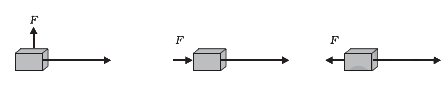
In each of the following a force, $F$ is acting on an object of mass, $m$. The direction of displacement is from west to east shown by the longer arrow. Observe the diagrams carefully and state whether the work done by the force is negative, positive or zero.
18.
An object thrown at a certain angle to the ground moves in a curved path and falls back to the ground. The initial and the final points of the path of the object lie on the same horizontal line. What is the work done by the force of gravity on the object?
19.
Look at the activities listed below. Reason out whether or not work is done in the light of your understanding of the term ‘work’.
• Suma is swimming in a pond.
• A donkey is carrying a load on its back.
• A wind-mill is lifting water from a well.
• A green plant is carrying out photosynthesis.
• An engine is pulling a train.
• Food grains are getting dried in the sun.
• A sailboat is moving due to wind energy.
20.
Soni says that the acceleration in an object could be zero even when several forces are acting on it. Do you agree with her? Why?

Worksheet Answers

This website uses cookies

We use cookies to improve user experience. Choose what cookies you allow us to use. You can read more about our Cookie Policy in our Privacy Policy

Accept All
Decline All
