UrbanPro

Your Worksheet is Ready

CBSE - Class 9 Science Structure of the Atom Worksheet

1.
For the following statements, write T for True and F for False.
(a) J.J. Thomson proposed that the nucleus of an atom contains only nucleons.
2.
Describe Bohr’s model of the atom.
3.
For the following statements, write T for True and F for False.
(b) A neutron is formed by an electron and a proton combining together. Therefore, it is neutral.
4.
For the following statements, write T for True and F for False.
(c) The mass of an electron is about $\frac{1}{2000}$ times that of proton.
5.
If $Z = 3$, what would be the valency of the element? Also, name the element.
6.
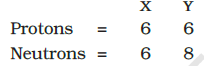
The average atomic mass of a sample of an element $X$ is 16.2 u. What are the percentages of isotopes $^{16}_8X$ and $^{18}_8X$ in the sample?
7.
Explain with examples (i) Atomic number. Give any two uses of isotopes.
8.
If bromine atom is available in the form of, say, two isotopes $^{79}_{35}Br$ (49.7%) and $^{81}_{35}Br$ (50.3%), calculate the average atomic mass of bromine atom.
9.
Explain with examples (ii) Mass number. Give any two uses of isotopes.
10.
$Na^+$ has completely filled $K$ and $L$ shells. Explain.
11.
Explain with examples (iii) Isotopes. Give any two uses of isotopes.
12.
What are the limitations of Rutherford’s model of the atom?
13.
Explain with examples iv) Isobars. Give any two uses of isotopes.
14.
What are the limitations of J.J. Thomson’s model of the atom?
15.
For the following statements, write T for True and F for False.
(d) An isotope of iodine is used for making tincture iodine, which is used as a medicine.
16.
Compare the properties of electrons, protons and neutrons.
17.

Rutherford’s alpha-particle scattering experiment was responsible for the discovery of

A)

Atomic Nucleus

B)

Electron

C)

Proton

D)

Neutron

18.

Isotopes of an element have

A)

the same physical properties

B)

different chemical properties

C)

different number of neutrons

D)

different atomic numbers.

19.

Number of valence electrons in $Cl^-$ ion are:

A)

16

B)

8

C)

17

D)

18

20.
Which one of the following is a correct electronic configuration of sodium?
A) (a) 2,8 B) (b) 8,2,1 C) (c) 2,1,8 D) (d) 2,8,1.

CBSE - Class 9 Science Structure of the Atom Worksheet

Answers

17.
18.
19.
20.

This website uses cookies

We use cookies to improve user experience. Choose what cookies you allow us to use. You can read more about our Cookie Policy in our Privacy Policy

Accept All
Decline All