UrbanPro

Your Worksheet is Ready

CBSE - Class 9 Science Motion Worksheet

1.
State which of the following situations are possible and give an example for each of these:
(b) an object moving with an acceleration but with uniform speed.
2.
Joseph jogs from one end A to the other end B of a straight 300 m road in 2 minutes 30 seconds and then turns around and jogs 100 m back to point C in another 1 minute. What are Joseph’s average speeds and velocities in jogging (b) from A to C?
3.
Abdul, while driving to school, computes the average speed for his trip to be $20 km h^{-1}$. On his return trip along the same route, there is less traffic and the average speed is $30 km h^{-1}$. What is the average speed for Abdul’s trip?
4.

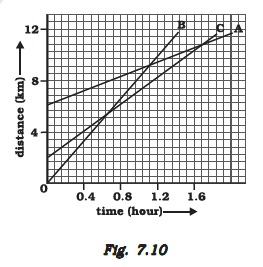
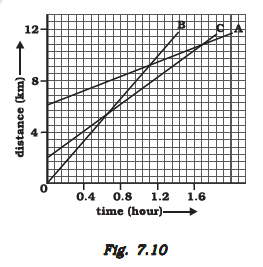
Fig 7.10 shows the distance-time graph of three objects A,B and C. Study the graph and answer the following questions:
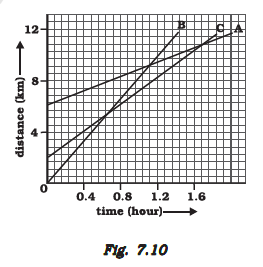
(c) How far has C travelled when B passes A?

5.

Fig 7.10 shows the distance-time graph of three objects A,B and C. Study the graph and answer the following questions:

(b) Are all three ever at the same point on the road?

6.
A motorboat starting from rest on a lake accelerates in a straight line at a constant rate of $3.0 m s^{-2}$ for 8.0 s. How far does the boat travel during this time?
7.
A driver of a car travelling at $52 km h^{-1}$ applies the brakes. (a) Shade the area on the graph that represents the distance travelled by the car during the period.
8.
An athlete completes one round of a circular track of diameter 200 m in 40 s. What will be the distance covered and the displacement at the end of 2 minutes 20 s?
9.
Joseph jogs from one end A to the other end B of a straight 300 m road in 2 minutes 30 seconds and then turns around and jogs 100 m back to point C in another 1 minute. What are Joseph’s average speeds and velocities in jogging (a) from A to B?
10.
An artificial satellite is moving in a circular orbit of radius 42250 km. Calculate its speed if it takes 24 hours to revolve around the earth.
11.

Fig 7.10 shows the distance-time graph of three objects A,B and C. Study the graph and answer the following questions:

(d) How far has B travelled by the time it passes C?

12.
State which of the following situations are possible and give an example for each of these:
(c) an object moving in a certain direction with an acceleration in the perpendicular direction.
13.

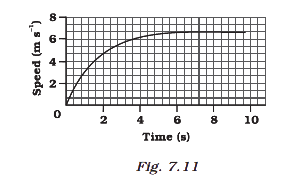
The speed-time graph for a car is shown is Fig. 7.11.
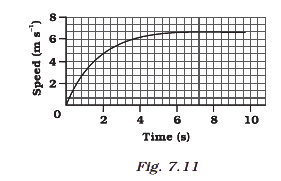
(a) Find how far does the car travel in the first 4 seconds. Shade the area on the graph that represents the distance travelled by the car during the period.

14.
A ball is gently dropped from a height of 20 m. If its velocity increases uniformly at the rate of $10 m s^{-2}$, with what velocity will it strike the ground? After what time will it strike the ground?
15.
State which of the following situations are possible and give an example for each of these:
(a) an object with a constant acceleration but with zero velocity
16.
A driver of a car travelling at $52 km h^{-1}$ applies the brakes. (b) Which part of the graph represents uniform motion of the car?
17.

The speed-time graph for a car is shown is Fig. 7.11.

(b) Which part of the graph represents uniform motion of the car?

18.

Fig 7.10 shows the distance-time graph of three objects A,B and C. Study the graph and answer the following questions:
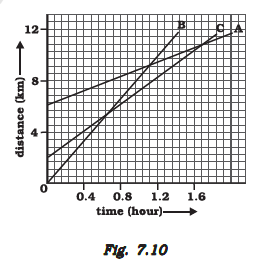
(a) Which of the three is travelling the fastest?


Worksheet Answers

This website uses cookies

We use cookies to improve user experience. Choose what cookies you allow us to use. You can read more about our Cookie Policy in our Privacy Policy

Accept All
Decline All