


Your Worksheet is Ready
CBSE - Class 9 Mathematics Heron’s Formula Worksheet
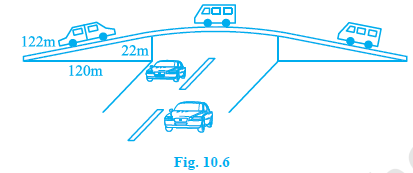
The triangular side walls of a flyover have been used for advertisements. The sides of the walls are 122 m, 22 m and 120 m (see Fig. 10.6). The advertisements yield an earning of ̀ 5000 per $m^2$ per year. A company hired one of its walls for 3 months. How much rent did it pay?
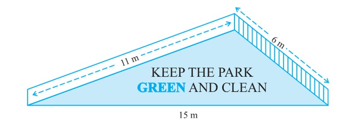
There is a slide in a park. One of its side walls has been painted in some colour with a message “KEEP THE PARK GREEN AND CLEAN” (see Fig. 10.7 ). If the sides of the wall are 15 m, 11 m and 6 m, find the area painted in colour.

Worksheet Answers
Solution:
Let the sides of the triangle be $a$, $b$, and $c$. Given that the triangle is isosceles, two sides are equal. We are provided with the following data:
By the definition of perimeter [Perimeter = Sum of all sides]:
$P = a + b + c$ $30 = 12 + 12 + c$ $30 = 24 + c$ $c = 30 - 24 = 6\text{ cm}$The semi-perimeter is defined as half of the perimeter [Perimeter definition]:
$s = \frac{P}{2} = \frac{30}{2} = 15\text{ cm}$The area ($A$) of a triangle with sides $a, b, c$ and semi-perimeter $s$ is given by [Heron’s Formula]:
$A = \sqrt{s(s - a)(s - b)(s - c)}$Substituting the values $s = 15$, $a = 12$, $b = 12$, and $c = 6$:
$A = \sqrt{15(15 - 12)(15 - 12)(15 - 6)}$ $A = \sqrt{15(3)(3)(9)}$Perform the multiplication and extract the square roots [Algebraic simplification]:
$A = \sqrt{15 \times 9 \times 9}$ $A = \sqrt{15 \times 81}$ $A = 9\sqrt{15}$Using the approximate value $\sqrt{15} \approx 3.873$:
$A \approx 9 \times 3.873 = 34.857\text{ cm}^2$Final Solution: The area of the isosceles triangle is $9\sqrt{15}\text{ cm}^2$ or approximately $34.86\text{ cm}^2$.
Solution:
Given the ratio of the sides of the triangle as $12:17:25$, let the common proportionality constant be $x$. Therefore, the lengths of the sides are defined as:
The perimeter ($P$) of the triangle is the sum of its three sides. Given $P = 540\text{ cm}$ [Per the definition of Perimeter]:
$12x + 17x + 25x = 540$
$54x = 540$
$x = \frac{540}{54} = 10$
Substituting the value of $x = 10$ into our algebraic expressions:
The semi-perimeter is defined as $s = \frac{a+b+c}{2}$:
$s = \frac{120 + 170 + 250}{2} = \frac{540}{2} = 270\text{ cm}$
The area ($A$) of a triangle is calculated using Heron's Formula: $A = \sqrt{s(s-a)(s-b)(s-c)}$ [Per Heron’s Theorem].
$A = \sqrt{270(270 - 120)(270 - 170)(270 - 250)}$
$A = \sqrt{270 \times 150 \times 100 \times 20}$
$A = \sqrt{(27 \times 10) \times (15 \times 10) \times (10 \times 10) \times (2 \times 10)}$
$A = \sqrt{(3^3 \times 10) \times (3 \times 5 \times 10) \times 10^2 \times (2 \times 10)}$
$A = \sqrt{270 \times 150 \times 100 \times 20} = \sqrt{81,000,000}$
$A = \sqrt{81 \times 10^6} = 9 \times 10^3 = 9000\text{ cm}^2$
Final Solution: The area of the triangle is $9000\text{ cm}^2$.
Solution:
Heron's Formula states that the area ($A$) of a triangle with sides $a$, $b$, and $c$ is given by:
$A = \sqrt{s(s-a)(s-b)(s-c)}$
where $s$ represents the semi-perimeter of the triangle, calculated as $s = \frac{a+b+c}{2}$ [By definition of semi-perimeter].
For an equilateral triangle, all sides are equal: $a = b = c$.
$A = \sqrt{\left(\frac{3a}{2}\right) \left(\frac{3a}{2} - a\right) \left(\frac{3a}{2} - a\right) \left(\frac{3a}{2} - a\right)}$
$A = \sqrt{\left(\frac{3a}{2}\right) \left(\frac{a}{2}\right) \left(\frac{a}{2}\right) \left(\frac{a}{2}\right)}$
$A = \sqrt{\frac{3a^4}{16}} = \frac{\sqrt{3}}{4} a^2$ [Algebraic simplification using property of square roots].
Given the perimeter ($P$) = $180\text{ cm}$. Since $P = 3a$ for an equilateral triangle:
$3a = 180 \implies a = \frac{180}{3} = 60\text{ cm}$.
Now, substitute $a = 60$ into the derived area formula:
$A = \frac{\sqrt{3}}{4} (60)^2$
$A = \frac{\sqrt{3}}{4} \times 3600$
$A = 900\sqrt{3}\text{ cm}^2$
| Parameter | Value |
|---|---|
| Side length ($a$) | $60\text{ cm}$ |
| Semi-perimeter ($s$) | $90\text{ cm}$ |
| Area calculation | $900\sqrt{3}\text{ cm}^2$ |
| Decimal Approximation ($\sqrt{3} \approx 1.732$) | $\approx 1558.8\text{ cm}^2$ |
Final Solution: The area of the signal board is $\frac{\sqrt{3}}{4} a^2$, which equals $900\sqrt{3}\text{ cm}^2$ (or approximately $1558.8\text{ cm}^2$).
Solution:
Given the dimensions of the triangular wall:
The semi-perimeter ($s$) of the triangle is calculated as [Per the definition of semi-perimeter in Heron’s formula]:
$s = \frac{a + b + c}{2} = \frac{122 + 22 + 120}{2} = \frac{264}{2} = 132\text{ m}$
Heron's Formula is defined as: $\text{Area} = \sqrt{s(s-a)(s-b)(s-c)}$ [Per Heron’s Theorem].
Substituting the values:
$\text{Area} = \sqrt{132(132 - 122)(132 - 22)(132 - 120)}$
$\text{Area} = \sqrt{132 \times 10 \times 110 \times 12}$
$\text{Area} = \sqrt{(132) \times 10 \times (11 \times 10) \times 12}$
$\text{Area} = \sqrt{132 \times 100 \times 132}$
$\text{Area} = \sqrt{132^2 \times 10^2} = 132 \times 10 = 1320\text{ m}^2$
The rental rate is ₹ $5000\text{ per m}^2\text{ per year}$. The company hires the wall for 3 months.
Time period in years = $\frac{3}{12} = \frac{1}{4}\text{ year}$
The rent paid is calculated as: $\text{Area} \times \text{Rate} \times \text{Time}$
$\text{Rent} = 1320 \times 5000 \times \frac{1}{4}$
$\text{Rent} = 1320 \times 1250$
$\text{Rent} = 1,650,000$
Final Solution: The company paid a total rent of ₹ 16,50,000.
Solution:
We are provided with the following dimensions for the triangle:
[By the definition of the perimeter of a triangle, $P = a + b + c$]
To apply Heron's Formula, we require the length of the third side ($c$). Using the perimeter formula:
$42 = 18 + 10 + c$
$42 = 28 + c$
$c = 42 - 28 = 14\text{ cm}$
The semi-perimeter is defined as half of the perimeter of the triangle:
$s = \frac{P}{2} = \frac{42}{2} = 21\text{ cm}$
Heron’s Formula for the area ($A$) of a triangle is given by:
$A = \sqrt{s(s-a)(s-b)(s-c)}$
Substituting the values $s = 21$, $a = 18$, $b = 10$, and $c = 14$:
$A = \sqrt{21(21-18)(21-10)(21-14)}$
$A = \sqrt{21 \cdot 3 \cdot 11 \cdot 7}$
Factorizing the terms inside the radical for precise extraction:
$A = \sqrt{(3 \cdot 7) \cdot 3 \cdot 11 \cdot 7}$
$A = \sqrt{3^2 \cdot 7^2 \cdot 11}$
$A = 3 \cdot 7 \sqrt{11}$
$A = 21\sqrt{11}\text{ cm}^2$
Final Solution: $21\sqrt{11}\text{ cm}^2$ (approximately $69.62\text{ cm}^2$)
Solution:
Given the side lengths of the triangular wall:
The semi-perimeter $s$ is defined as half of the sum of the sides of the triangle [By the definition of semi-perimeter]:
$s = \frac{a + b + c}{2}$
$s = \frac{15 + 11 + 6}{2}$
$s = \frac{32}{2} = 16\text{ m}$
The area ($A$) of a triangle with sides $a, b, c$ and semi-perimeter $s$ is given by:
$A = \sqrt{s(s - a)(s - b)(s - c)}$ [Heron's Theorem]
Substituting the values:
$A = \sqrt{16(16 - 15)(16 - 11)(16 - 6)}$
$A = \sqrt{16 \cdot (1) \cdot (5) \cdot (10)}$
$A = \sqrt{16 \cdot 50}$
$A = \sqrt{800}$
$A = \sqrt{16 \cdot 25 \cdot 2}$
$A = \sqrt{4^2 \cdot 5^2 \cdot 2}$
$A = 4 \cdot 5 \cdot \sqrt{2}$
$A = 20\sqrt{2}\text{ m}^2$
Given that $\sqrt{2} \approx 1.414$:
$A \approx 20 \cdot 1.414 = 28.28\text{ m}^2$
Final Solution: The area painted in colour is $20\sqrt{2}\text{ m}^2$ or approximately $28.28\text{ m}^2$.


