


Your Worksheet is Ready
CBSE - Class 9 Mathematics Quadrilaterals Worksheet
A trader has a success rate of 60% and Profit Factor of 4.5. Is the trader profitable?
Yes
b.No
c.Can't be determined
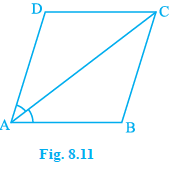
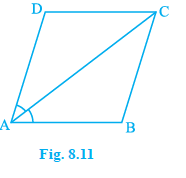
Diagonal $AC$ of a parallelogram $ABCD$ bisects $\angle A$ (see Fig. 8.11). Show that (i) it bisects $\angle C$ also,
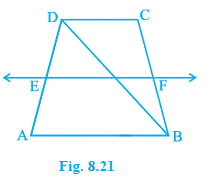
$ABCD$ is a trapezium in which $AB \| DC$, $BD$ is a diagonal and $E$ is the mid-point of $AD$. A line is drawn through $E$ parallel to $AB$ intersecting $BC$ at $F$ (see Fig. 8.21). Show that $F$ is the mid-point of $BC$.
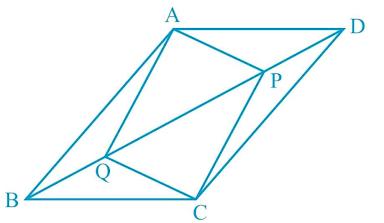
In parallelogram $ABCD$, two points $P$ and $Q$ are taken on diagonal $BD$ such that $DP = BQ$ (see Fig. 8.12). Show that: (iii) $\Delta AQB \cong \Delta CPD$

A trader with a success rate of 60% and Profit Factor of 4.5 incurrs a disproportionately heavy loss. Which KPI (s) will be impacted significantly:
Success rate
b.Profit Factor
c.Both will be equally impacted
d.None of them will be impacted
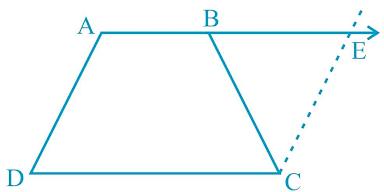
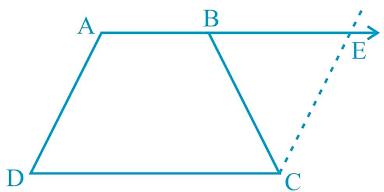
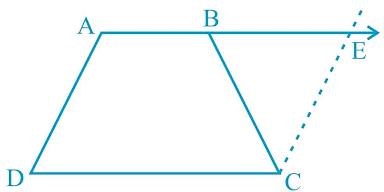
$ABCD$ is a trapezium in which $AB \| CD$ and $AD = BC$ (see Fig. 8.14). Show that (i) $\angle A = \angle B$ [Hint : Extend $AB$ and draw a line through $C$ parallel to $DA$ intersecting $AB$ produced at $E$.]

A trader with 30% success rate is immensely more profitable than another trader with 60% success rate (everything else being the same). What do you think may be the problem with the second trader (select all possibilities)?
Not lucky enough
b.Not taking bigger profits
c.Taking bigger losses
$ABCD$ is a trapezium in which $AB \| CD$ and $AD = BC$ (see Fig. 8.14). Show that (ii) $\angle C = \angle D$ [Hint : Extend $AB$ and draw a line through $C$ parallel to $DA$ intersecting $AB$ produced at $E$.]

Diagonal $AC$ of a parallelogram $ABCD$ bisects $\angle A$ (see Fig. 8.11). Show that (ii) $ABCD$ is a rhombus.
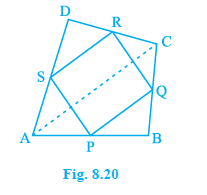
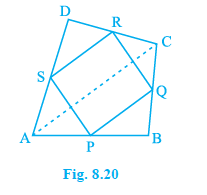
$ABCD$ is a quadrilateral in which $P, Q, R$ and $S$ are mid-points of the sides $AB, BC, CD$ and $DA$ (see Fig 8.20). $AC$ is a diagonal. Show that : (iii) $PQRS$ is a parallelogram.
$ABCD$ is a trapezium in which $AB \| CD$ and $AD = BC$ (see Fig. 8.14). Show that (iv) diagonal $AC$ = diagonal $BD$ [Hint : Extend $AB$ and draw a line through $C$ parallel to $DA$ intersecting $AB$ produced at $E$.]

In parallelogram $ABCD$, two points $P$ and $Q$ are taken on diagonal $BD$ such that $DP = BQ$ (see Fig. 8.12). Show that: (iv) $AQ = CP$

$ABCD$ is a quadrilateral in which $P, Q, R$ and $S$ are mid-points of the sides $AB, BC, CD$ and $DA$ (see Fig 8.20). $AC$ is a diagonal. Show that : (ii) $PQ = SR$
Worksheet Answers
Solution:
With this success rate, the only way this trader would be unprofitable if the profit factor becomes much lower than 1.
Solution:
As far as success rate is concerned, this is just another losing trade and would be counted as 1. The real damage will be seen in the Profit Factor.


